
TELEHEALTH & VIRTUAL VISITS | MIDTOWN MANHATTAN, NEW YORK CITY
Telehealth Visits in NYC:
Virtual Primary Care at Atrium Medical
Published by
Dr. Shilpa Paradkar Singh, MD | Last reviewed June 2026

- Same-Day Telehealth
15–20 Minute Virtual Visits
- Your Atrium Clinician
Same Team, Same Chart
- Labs & Referrals
Ordered When Appropriate
- No Midtown Commute
Care From Home or Office
Fast answer
A televisit is a medical appointment by video or phone. At Atrium Medical in Midtown Manhattan, telehealth is part of a real primary care relationship — not a one-off transaction with a random clinician who has never seen you before.
That distinction matters. When your Atrium clinician sees you by video, they already know your medications, your labs, your history, and your risk factors. A televisit at Atrium can include a real clinical evaluation, prescriptions when appropriate, lab orders, referrals, and a follow-up plan. It is the same care, without the commute.
Most Atrium telehealth visits run 15 to 20 minutes. Same-day and next-day slots are often available. To schedule, book online or call 212-457-1722. We accept Aetna, Cigna, Blue Cross Blue Shield, UnitedHealthcare, Oxford, and most major insurance plans.
On This Page
- What is a televisit?
- Telehealth app versus your primary care doctor
- Telehealth and the Midtown workday
- What is appropriate for a televisit?
- What is NOT appropriate for a televisit?
- How a televisit works at Atrium
- What Atrium can do after a televisit
- Telehealth for specific visit types
- Insurance and billing for telehealth visits
- Can I do a televisit as a new patient?
- Telehealth FAQ
What is a televisit?
A televisit — also called a telehealth visit or virtual visit — is a medical appointment conducted by secure video or phone with a licensed clinician. It is still a real medical appointment. It includes a clinical history review, symptom evaluation, medical decision-making, a treatment plan, and prescriptions or orders when clinically appropriate.
What it is not: a chatbot, a symptom checker, or an automated questionnaire that routes you to a generic answer. A televisit at Atrium is conducted by the same clinician team you would see in person.
Telehealth app versus your primary care doctor
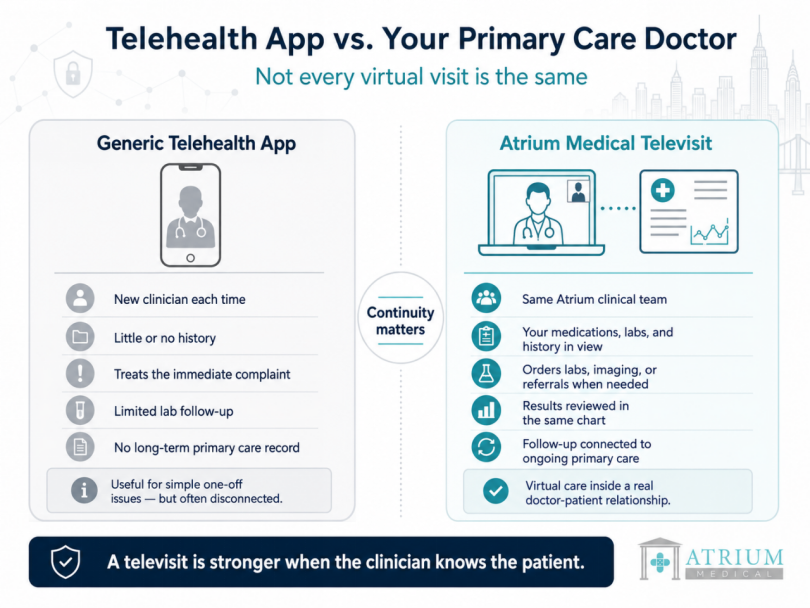
Telehealth apps — platforms like Teladoc, MDLive, or ZocDoc On-Demand — can be useful for genuinely simple one-off problems when you have no existing medical relationship. But for most primary care needs, a televisit through your own practice is meaningfully different.
| Random telehealth app | Atrium Medical televisit |
|---|---|
| Clinician sees you for the first time with no prior context. | Your clinician already knows your medications, allergies, lab trends, and medical history. |
| Treats the immediate complaint and closes the visit. | Places your symptoms in context of your full clinical picture. |
| Cannot easily order your labs or follow up on results. | Can order labs, imaging, and referrals and follow up on results at the next visit. |
| You start over with a new provider every time. | Continuity: same team, same chart, same relationship. |
| No connection to your primary care record. | Every telehealth visit becomes part of your longitudinal record at Atrium. |
Telehealth and the Midtown workday
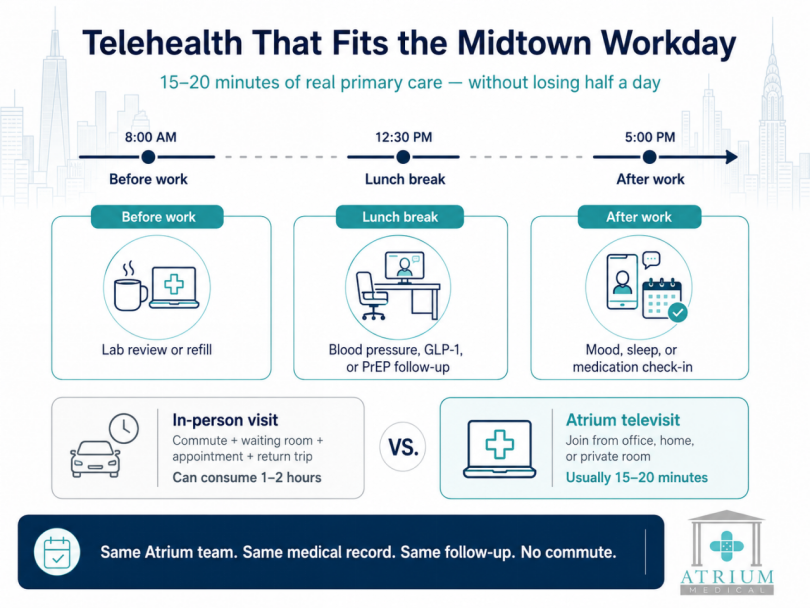
For Midtown Manhattan patients — office workers near Park Avenue, Lexington, Bloomberg, JPMorgan, Citigroup Center, the Plaza District, or residential patients in Sutton Place, Turtle Bay, and Beekman Hill — the friction of getting to a doctor’s office during the workday is real. A two-hour round trip for a 20-minute lab review conversation is not a good use of anyone’s time.
Most Atrium televisits run 15 to 20 minutes. They can fit into a before-work slot, a lunch break, or right after the close of business. For visits that are genuinely better handled by video — lab results, medication adjustments, GLP-1 dose discussions, blood pressure check-ins, anxiety or depression follow-ups, refills — a televisit is not a compromise. It is the more efficient option.
What is appropriate for a televisit?
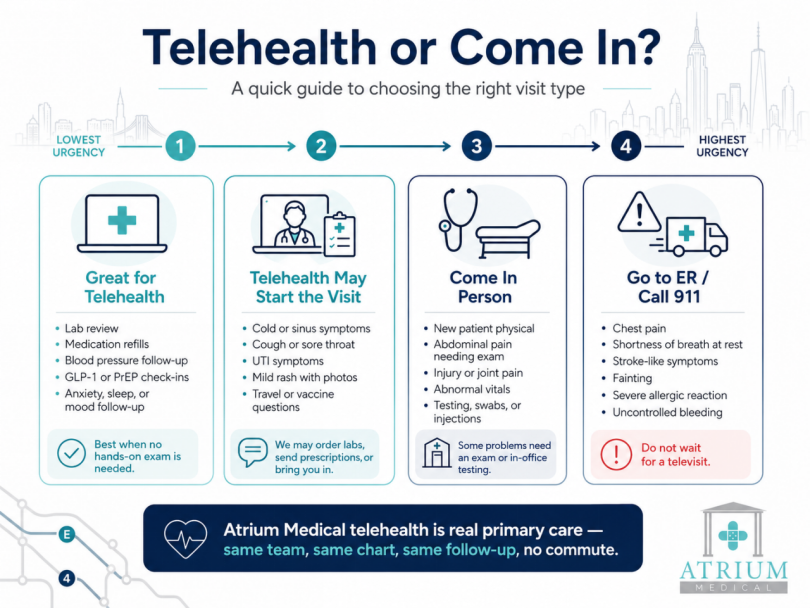
Many common primary care needs can be handled well by telehealth when the clinician knows the patient and the visit type fits the problem. Below is a representative list, not exhaustive:
- Cold and sinus symptoms without red-flag features
- Sore throat in appropriate clinical context
- Cough and mild respiratory symptoms
- Urinary symptoms in many cases
- Pink eye with photo review
- Mild skin rashes -- photo submission helps
- Medication refills when clinically appropriate and monitoring is current
- Lab review, results counseling, and follow-up planning
- Blood pressure check-ins and medication titration
- Anxiety, depression, and mood follow-ups
- Sleep issues and fatigue follow-up
- GLP-1 weight loss dose discussions, side-effect check-ins, and maintenance planning
- PrEP monitoring visits and STI discussion
- Annual physical lab review after the in-person exam
- Pre-travel counseling and vaccine discussion
- Preventive counseling and care planning when no exam is needed
When in doubt, call or book and describe the issue. We will tell you whether telehealth is the right format or whether we need you in person.
What is NOT appropriate for a televisit?
Some symptoms require an in-person examination, immediate labs, or emergency evaluation that cannot happen remotely. If you have any of the following, do not wait for a telehealth slot:
- Chest pain or pressure
- Shortness of breath at rest
- Fainting or severe dizziness
- Stroke-like symptoms: sudden weakness, facial drooping, slurred speech, vision loss
- Severe abdominal pain
- High fever with significant worsening
- Significant injury or possible fracture
- Severe allergic reaction or anaphylaxis
- Uncontrolled bleeding
For these symptoms, call 911 or go to an emergency room immediately. For guidance on when primary care, urgent care, or the ER is the right setting, see urgent care versus primary care.
If a clinician starts a telehealth visit and determines the problem cannot be safely evaluated remotely, we will guide you to the appropriate next step and coordinate an in-person visit or urgent evaluation when needed.
How a televisit works at Atrium
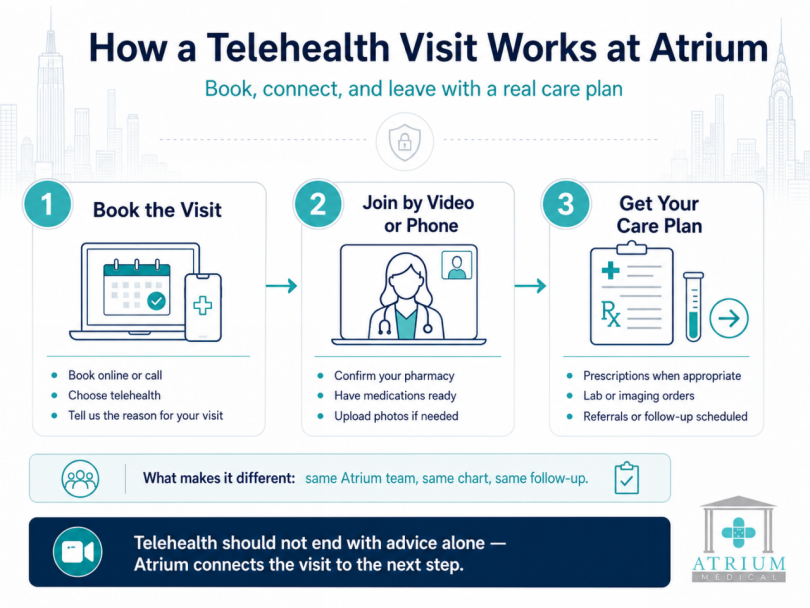
- Book online or call 212-457-1722 and select the telehealth visit type. Let the team know the reason for the visit so the right time slot is allocated.
- Before the visit, confirm your pharmacy, have your current medication list ready, and upload any relevant photos if needed — for example, a photo of a rash or skin change.
- Join the visit by secure video or phone at the scheduled time. Your clinician reviews your history, evaluates the symptoms, and builds a plan.
- After the visit, prescriptions are sent to your pharmacy when appropriate, lab orders are placed if needed, and follow-up is scheduled through the same office.
What Atrium can do after a televisit
A televisit at Atrium is not a dead end. If the next step requires testing, imaging, or specialist input, we can order and coordinate it:
- Bloodwork at a local lab
- Urine testing
- Imaging: ultrasound, X-ray, CT, MRI referrals
- Specialist referrals to physicians at NYU Langone, Mount Sinai, HSS, Weill Cornell, Northwell, or other preferred networks
- Severe abdominal pain
- Follow-up televisit or in-person appointment
Televisits often serve as the most efficient first step in directing care to the right setting quickly.
Telehealth for specific visit types
Telehealth is not one-size-fits-all. Different visit types have different telehealth dynamics:
| Visit type | Telehealth suitability |
|---|---|
| Lab results review and counseling | Excellent. This is one of the highest-value telehealth use cases. No exam needed, and patients benefit from a real conversation about what the numbers mean. |
| Medication refill | Often appropriate when monitoring is current and the clinical situation is stable. Some medications require more frequent in-person review. |
| Blood pressure management | Good for follow-up once baseline is established. Patients with a home cuff can provide readings. Dose adjustments are often handleable remotely. |
| GLP-1 weight loss follow-up | Good for side-effect check-ins, dose discussions, and maintenance planning when labs and vitals have been recently completed in person. |
| PrEP monitoring | Appropriate for counseling and planning visits when HIV testing and labs are current. Actual testing requires an in-person or lab visit. |
| Anxiety and depression follow-up | Good fit when the patient is established and the goal is medication adjustment, counseling, or referral discussion. |
| New patient comprehensive visit | Often better in person for the first visit so a baseline physical exam and labs can be completed. Some new patients can start with a televisit depending on the presenting need. |
| UTI symptoms | Often appropriate if the patient is an established patient with a straightforward history. Urine testing may still require a lab visit. |
Insurance and billing for telehealth visits
Telehealth visits at Atrium are billed like standard medical appointments. Your standard copay, coinsurance, and deductible rules apply in the same way they would for an in-person visit.
A few things to know:
- Your plan may treat a telehealth visit as a standard office visit or as a telehealth-specific benefit. Coverage rules vary by employer plan.
- Medication costs are separate from the visit cost and billed through your pharmacy benefit.
- Lab costs, imaging costs, and specialist fees from any follow-up orders are billed separately by those providers.
- If you have questions about coverage before booking, our team can help you understand how your plan typically works.
Can I do a televisit as a new patient?
In many cases, yes. For straightforward concerns where an exam is not immediately required — a simple sick visit, a medication question, a results review — a telehealth visit can be a reasonable starting point even if you are new to Atrium.
For patients who want to establish ongoing primary care, we often recommend an in-person new patient visit first. That allows us to do a full physical exam, baseline labs, and a complete history review. After that, televisits work well for follow-up, refills, and routine check-ins.
If you are unsure which to start with, call the office and describe what you need. We will recommend the most efficient starting point.
Telehealth FAQ
A televisit is a visit with a licensed medical clinician conducted by secure video or phone. It is a real medical appointment that includes a clinical evaluation, a treatment plan, prescriptions when appropriate, and follow-up coordination.
Cold and sinus symptoms, sore throat in appropriate cases, cough, urinary symptoms, pink eye, mild rashes, medication refills when clinically appropriate, lab review, blood pressure check-ins, anxiety and depression follow-ups, GLP-1 and weight loss check-ins, PrEP monitoring, and preventive counseling are all commonly handled by televisit at Atrium.
Chest pain, shortness of breath at rest, stroke symptoms, severe abdominal pain, high fever with significant worsening, possible fracture, severe allergic reaction, and uncontrolled bleeding all require in-person or emergency evaluation. Call 911 or go to an emergency room if you have these symptoms.
Your Atrium clinician already knows your history, medications, allergies, and labs. A televisit at Atrium is part of your longitudinal care record -- not a one-off with a stranger. We can coordinate follow-up, order labs, and place referrals in a way that a standalone app cannot.
Most televisits run 15 to 20 minutes depending on the complexity of the visit.
No. Most patients use a smartphone, tablet, or computer with a stable internet connection. If you have a thermometer, blood pressure cuff, or pulse oximeter at home, those can be useful for visits involving those measurements but are not required.
Often yes, depending on the condition and clinical context. Some medications require an in-person exam, specific labs, or controlled-substance evaluation requirements. We handle prescribing decisions based on medical appropriateness and safety.
Yes. If needed, Atrium can order bloodwork, urine testing, imaging, and specialist referrals after a televisit. Televisits are often the most efficient first step in directing care to the right next setting.
Most major insurance plans cover telehealth visits. A televisit is generally billed like a standard office visit with your usual copay, coinsurance, and deductible rules applying. Check your specific plan for telehealth coverage terms.
In many cases yes, depending on the visit type. For establishing ongoing primary care, we often recommend an in-person new patient visit first. Call the office and we will recommend the most efficient starting point.
Call 212-457-1722 or book online and select the telehealth visit type. Same-day and next-day slots are often available.
Medical sources and official references
This page was reviewed by Atrium Medical Primary Care. Sources may be updated as guidelines change.
Book a Telehealth Visit at Atrium Medical
Same care. No commute. Atrium Medical offers telehealth visits for a wide range of primary care needs, with the same clinical team, the same medical record, and the same follow-up as an in-person visit
Atrium Medical is located at 160 East 56th Street, 12th Floor, in Midtown East. For in-person visits we are three blocks from the 59th Street subway hub. For telehealth, you can join from anywhere. Book a telehealth visit or call 212-457-1722.