
ADVANCED BIOMARKERS | LAB INTERPRETATION | MIDTOWN MANHATTAN, NEW YORK CITY
Got Your Function Health, Superpower, or Marek Health Results? Here’s What a Board-Certified Internist Actually Does With Them
Published by Dr. Shilpa Paradkar Singh, MD
Board-Certified Internal Medicine | Founder, Atrium Medical Primary Care, NYC
Published August 2026

- Bring Your Panel
Make sense of the numbers.
- ApoB, Lp(a), Insulin
The markers that matter.
- Context Is Everything
Symptoms, history, meds.
- You Need a Plan
Not another supplement stack.
Fast answer
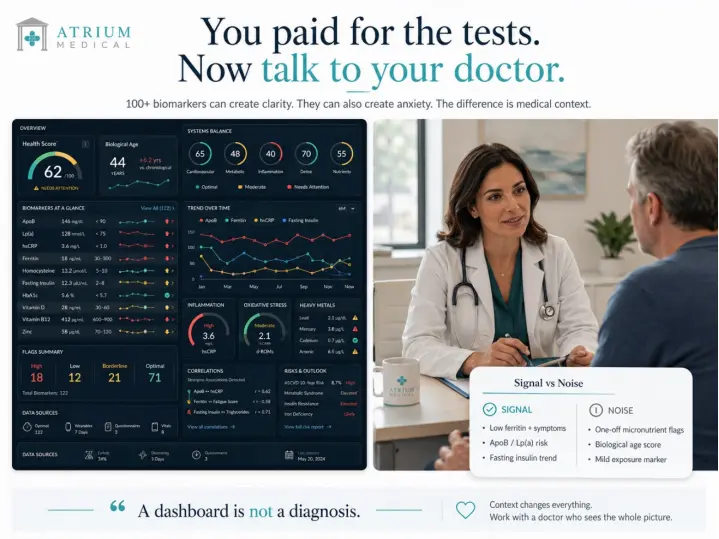
Direct-to-consumer lab panels can be useful, but “flagged” biomarkers are not diagnoses. A result outside the reference range needs clinical context: symptoms, medications, family history, menstrual history, diet, supplements, exposures, and whether the result would actually change care.
At Atrium Medical in Midtown Manhattan, patients bring outside lab panels and functional medicine dashboards for physician interpretation. We help separate meaningful signals — ApoB, Lp(a), fasting insulin, hsCRP, ferritin in the right clinical context — from false alarms, supplement-driven abnormalities, and noise intended to steer patients towards expensive, branded protocols. The goal is not to sell expensive tests and supplement stacks. It is to decide what should be repeated, what can be ignored, and what needs a medically credible plan: in other words, what really matters for your health.
On This Page
- The note you received is not what you think it is
- What a reference range actually means
- The advanced biomarkers worth taking seriously
- Markers that often create more anxiety than answers
- The Clinical Interpretation
- The question worth asking
- Advanced Biomarker FAQ
The note you received is not what you think it is
A patient came in last month with a thick printout and a lot of anxiety. She’d paid around $500 for a direct-to-consumer lab panel, got over 100 biomarkers back, spent two weeks going down Reddit and Instagram rabbit holes, and arrived in my office convinced something was seriously wrong because of seven flagged markers. We spent forty minutes together.
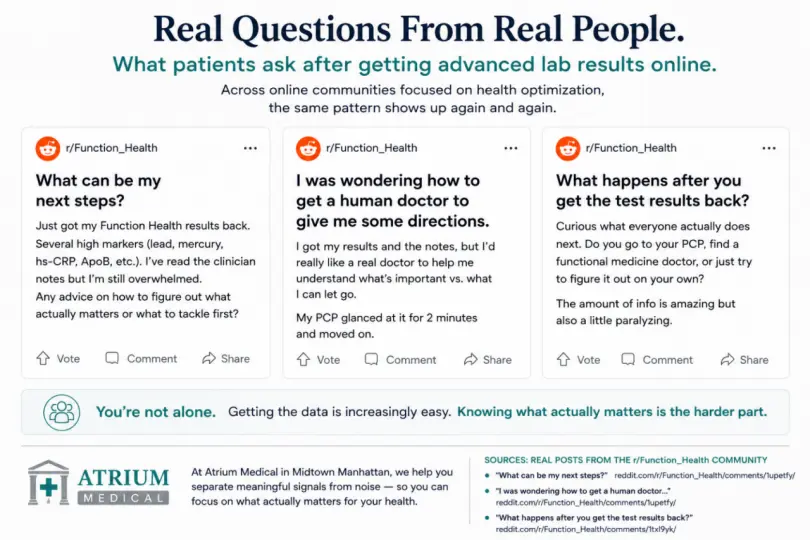
It turns out this patient isn’t the only one. Spend a few minutes scrolling through online communities devoted to advanced testing and the pattern becomes obvious. Patients aren’t struggling to obtain more data. They’re struggling with what to do after they get it. People post screenshots of flagged biomarkers, ask strangers whether they should be worried, feed their results into AI, start supplements, or try to find a physician willing to review the entire panel. The technology has made sophisticated laboratory testing remarkably accessible. Clinical interpretation has not scaled at the same rate.
This is not a criticism of the platforms themselves. It is a structural limitation of any service designed to translate a patient into a machine-readable data set at scale. In fact, the direct-to-consumer testing platforms have done something genuinely useful. They have put a spotlight on where traditional internal medicine sometimes falls short, not because doctors don’t want to do more, but because insurance often gets in the way. These panels exist because that gap is real.
What they cannot do well is tell you what any of it means for you specifically. When your results come back flagged, you receive what some platforms call a clinician note. It explains what the marker is, why it matters in general, and what the population-level guidance says. Every person with that same flag receives essentially the same note. It was written, reviewed, and deployed at scale to hundreds of thousands of members. It is not a physician reading and thinking about your case. It is a content block with a medical credential attached. The math of a few hundred dollars per year does not support individual clinical interpretation.
None of this is hidden. Their own terms say it plainly. At the end of every results page, they tell you to talk to a doctor. That instruction is doing a lot of heavy lifting.
What a reference range actually means
A flag means one thing: your result fell outside the range observed in a reference population. It does not mean you are sick. It does not mean you need a supplement, a hormone, or a peptide. It means your number was unusual relative to a population that may or may not resemble you in any meaningful way.
Reference ranges don’t know that you spent the summer in a wooded area. That your father had a heart attack at 58. That you’ve been on a statin for two years that may not be optimized for your particle type. That your sleep has been poor for two months since a job change or a new baby. That your family history of hemochromatosis makes your ferritin read completely differently than it would in someone without it.
Context is the entire job. That needs a clinician’s time, training, and willingness to engage.
The advanced biomarkers worth taking seriously
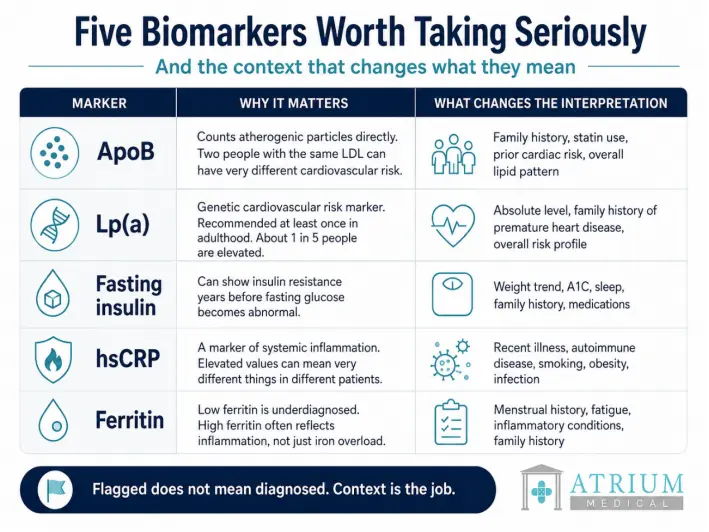
ApoB: ApoB directly counts the atherogenic particles in your blood — the ones that actually drive plaque buildup in your arteries. Two people can have identical LDL and wildly different cardiovascular risk depending on their ApoB. The 2026 ACC/AHA dyslipidemia guidelines now formally recognize ApoB as an additional tool for cardiovascular risk assessment, particularly when a standard lipid panel may underestimate atherogenic particle burden. For years it wasn’t part of routine primary care screening for most patients. If your panel flagged ApoB, I want to see it.
Lp(a): The same 2026 guidelines now recommend every adult measure Lp(a) at least once in their lifetime. Class I recommendation — the strongest designation in cardiology. Lp(a) is almost entirely genetic, doesn’t change meaningfully with diet or exercise, and if elevated tells us your baseline cardiovascular risk is higher than a standard lipid panel would ever show. About one in five people have elevated Lp(a). Most have no idea.
For a separate estimate of your 10- and 30-year cardiovascular risk using the AHA PREVENT equations, try Atrium’s PREVENT Heart Risk Visualizer.
Fasting insulin: Not included in a typical annual physical. Tells your clinician more about your metabolic trajectory than fasting glucose alone. Fasting insulin can reveal compensatory hyperinsulinemia while fasting glucose is still normal, providing valuable additional context.
hsCRP: Systemic inflammation. Elevated hsCRP in an otherwise healthy person prompts a very different workup than in someone with autoimmune disease or obesity. Context is everything.
Ferritin: Flagged constantly, misinterpreted constantly. High ferritin can reflect iron overload, but it’s also an acute phase reactant — it goes up whenever your body is inflamed for any reason. Low ferritin in premenopausal women is vastly underdiagnosed and explains a significant share of the fatigue and brain fog that gets labeled anxiety or burnout.
Something worth knowing about those five markers
Until recently these were largely cash-pay tests — exactly the kind of markers direct-to-consumer platforms built their value proposition around. Guideline changes precede coverage changes. With the new cardiology guidelines formally backing ApoB and Lp(a), those tests may be easier to justify through insurance when there is a documented clinical reason.
At our practice, patients report paying somewhere between $100 and $200 out of pocket through standard labs for the markers I focus on most often in this context. Sometimes we manage to get some of them covered, especially when there is documented medical justification. Your mileage may vary.
Markers that often create more anxiety than answers
Homocysteine. Flagged constantly. People immediately buy methylfolate and B12. The evidence that lowering homocysteine with B vitamins actually reduces cardiovascular events is, to put it charitably, unimpressive. Worth knowing about. Rarely changes what I do.
Most micronutrient flags. Vitamin D insufficiency is real and common. But if your zinc, selenium, manganese, or copper shows up slightly out of range, that warrants clinical judgment — not an immediate trip to the supplement aisle. The supplement industry has a deep and abiding love for abnormal micronutrient results. Your wallet should be more skeptical than your dashboard.
Heavy metals. Lead and mercury are worth taking seriously in the right context — significant fish consumption, older housing, occupational exposure. But the mildly elevated cobalt or arsenic on an otherwise healthy professional’s panel is almost never an emergency. The wellness industry has built an entire revenue stream around these results flowing into IV chelation protocols. The actual clinical threshold for chelation in an asymptomatic adult is significantly higher than what these panels flag. Most of the time the answer is a dietary conversation, not an infusion.
Biological age scores. If your epigenetic clock says you’re 3.7 years younger than your chronological age — wonderful. Pop open a kombucha, post it to your Instagram story, savor the moment. If it says you’re 2.3 years older — take a deep breath. It means approximately nothing. These scores fluctuate month to month based on factors that have nothing to do with how fast you’re actually aging. They are interesting research tools that got productized before the science was ready for prime time. They are not a diagnosis. They are not an oracle. They are a very expensive horoscope with a better aesthetic.
The Clinical Interpretation
Back to my patient. Her ferritin was flagged low. The note explained iron deficiency. What it couldn’t tell her is that her ferritin at her age, combined with the fatigue she’d dismissed as stress, the hair thinning she was too embarrassed to mention to anyone, and her menstrual history, was the most likely explanation for symptoms she’d been managing with caffeine and willpower for six months.
Speaking of ferritin, many patients have seen on their social media feeds that iron is absorbed best in an acidic environment, which is why they take it with vitamin C or citrus. Interestingly, a randomized trial found that adding vitamin C to oral iron did not meaningfully improve hemoglobin or ferritin compared with iron alone. What often matters more is what you take iron without: calcium, coffee, tea (those pesky polyphenols!) and acid-suppressing medications can interfere with absorption. And before simply adding more iron or changing how you take it, the more important question still stands: why your ferritin is low in the first place?
Her other six flags? Noise. Two were likely caused by supplements she’d been overdoing — supplements she’d bought, it should be noted, from the same platform that sold her the panel. One was probably a diet-related exposure signal, the kind that should be repeated and interpreted with a food and exposure history before anyone starts talking about a detox or chelation.
She left my office without a peptide protocol or a new supplement stack. She left with one medication adjustment, a referral to a nutritionist, and a plan. I’m seeing her again in about three months. We’ll run the labs that matter ourselves — and we’ll make sure she gets on the right track.
The question worth asking
The dashboard you paid for should be preparing you to have a more informed conversation with a physician. It cannot substitute for one.
If you have a physician that has the time to listen, the dashboard you paid for is a useful tool they can work with. If you don’t, you have a sophisticated anxiety generator with very slick branding.
They told you to talk to your doctor. So do that.
Advanced Biomarker FAQ
Can I bring my Function Health or Marek Health results to Atrium Medical?
Yes. Patients can bring outside lab panels, functional medicine results, or advanced biomarker dashboards to Atrium for physician interpretation. Our clinicians review what each result means in the context of your symptoms, medications, family history, and overall clinical picture.
What does a flagged biomarker actually mean?
A flagged result means your number fell outside the range observed in a reference population. It does not mean you are sick, that you need a supplement, or that you need a new protocol. It means the result needs clinical context — symptoms, medications, family history, exposures, and whether the result would actually change care.
Is ApoB covered by insurance now?
The 2026 AHA/ACC dyslipidemia guidelines now formally recommend ApoB measurement for cardiovascular risk assessment, which may support insurance coverage when there is a documented clinical reason. Coverage varies by plan and insurer.
What is Lp(a) and why does it matter?
Lipoprotein(a), or Lp(a), is a genetically determined cardiovascular risk factor. The 2026 AHA/ACC guidelines recommend that every adult measure Lp(a) at least once in their lifetime — a Class I recommendation, the strongest designation in cardiology. About one in five people have elevated Lp(a), most without knowing it. It does not change meaningfully with diet or exercise, and if elevated it indicates your cardiovascular risk is higher than a standard lipid panel would show.
Why doesn't my regular doctor order fasting insulin?
Fasting insulin is not part of standard annual physical labs under some insurance protocols. It provides more information about your metabolic trajectory than fasting glucose alone, because insulin resistance shows up in fasting insulin years before glucose reaches pre-diabetic range. At Atrium, we can order it and interpret it in the context of your full metabolic picture.
Are biological age scores from DTC panels medically meaningful?
Not reliably. Epigenetic biological age scores fluctuate month to month based on factors unrelated to how fast you are actually aging. They are research tools that were productized before the science was ready for clinical use. They are not a diagnosis and should not drive medical decisions or supplementation protocols.
Should I stop my supplements before getting labs drawn?
Depends on which supplements and which labs. Some supplements directly affect results — biotin in very high doses can interfere with multiple immunoassay tests, high-dose vitamin D affects its own measurement, iron supplements affect ferritin. If you are planning a draw, call Atrium before stopping anything, especially if you are on a complex supplement protocol from a DTC platform.
How much do these labs cost if my insurance doesn't cover them?
It depends on which tests and which lab. Atrium patients report paying roughly $100 to $200 out of pocket through standard commercial labs for the five markers we most commonly discuss: ApoB, Lp(a), fasting insulin, hsCRP, and ferritin. Sometimes all five are covered by insurance when there is a documented clinical reason. The platform price often includes packaging, dashboard access, interpretation notes, and membership infrastructure, not just the underlying lab draw.
Clinical sources and references
This page reflects the clinical perspective of Dr. Shilpa Paradkar Singh, MD, and current published guideline recommendations as of June 2026. Sources below.
- 2026 AHA/ACC Dyslipidemia Guidelines — ApoB and Lp(a) recommendations
- ACC: Lp(a) clinical guidance and patient information
- JAMA: reference range limitations in laboratory medicine
- Cochrane Review: homocysteine-lowering interventions and cardiovascular events
- NIH MedlinePlus: understanding laboratory tests
- Function Health: Does Function replace my doctor?
- Biotin interference in immunoassay testing — FDA safety communication
- The Efficacy and Safety of Vitamin C for Iron Supplementation in Adult Patients With Iron Deficiency AnemiaA Randomized Clinical Trial
Book a Biomarker Interpretation Visit
If you have already paid for a direct-to-consumer lab panel, advanced biomarker dashboard, functional medicine panel, or longevity test, you can bring the full report to Atrium Medical. Your Atrium clinician can help determine which results matter, which should be repeated through standard labs and what actually needs treatment or follow-up.
Atrium Medical is located at 160 East 56th Street, 12th Floor, in Midtown East Manhattan, near the 59th Street subway hub and Grand Central. Book a lab review visit or call 212-457-1722.