
Published by
Dr. Shilpa Paradkar Singh, MD | Last reviewed June 2026
In NYC, urgent care is useful when you need a quick, one-time visit and your primary care doctor is not available. But for many common same-day issues — sore throat, cough, UTI symptoms, sinus symptoms, rashes, medication questions, blood pressure checks, or recurring symptoms — a primary care visit can be the better first stop.
At Atrium Medical in Midtown Manhattan, we can often see patients same-day or same-week for issues commonly taken to CityMD, while also giving you what urgent care usually cannot: continuity, follow-up, lab tracking, medication review, and a clinical team that knows your history.
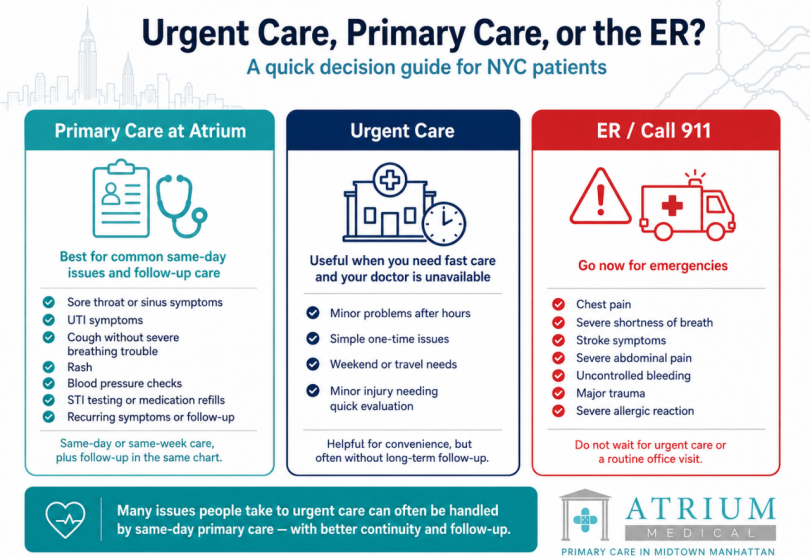
Use urgent care when the issue is simple, not life-threatening, and your primary care office is closed or unavailable.
Use primary care when symptoms are recurring, unclear, tied to your medications or lab history, or likely to need follow-up.
IF YOUR SYMPTOMS ARE LIFE-THREATENING, DO NOT READ THIS PAGE
Call 911 or go to the nearest emergency room immediately for: chest pain, severe shortness of breath, stroke symptoms, severe abdominal pain, uncontrolled bleeding, major trauma, severe allergic reaction, or anaphylaxis.
Urgent care is a walk-in or short-notice medical clinic designed for non-emergency problems that need attention quickly. Urgent care clinics focus on treating one issue per visit. They do not maintain your longitudinal medical record, order follow-up labs, or manage chronic conditions over time.
In NYC, CityMD is the most recognized urgent care chain. You have likely seen one on nearly every Midtown block. That visibility and convenience is part of why urgent care became the default for so many New Yorkers, especially those without an established primary care relationship.
Â
Primary care is your long-term medical home. It is where a board-certified physician manages your preventive care, sick visits, medications, chronic conditions, lab trends, referrals, and overall health trajectory over time.
At Atrium Medical, primary care is delivered by a consistent team at a single Midtown Manhattan office. We are an independent internal medicine practice, which means we are not a hospital system, not a chain, and not a rotating urgent-care desk. One chart, one team, one relationship.
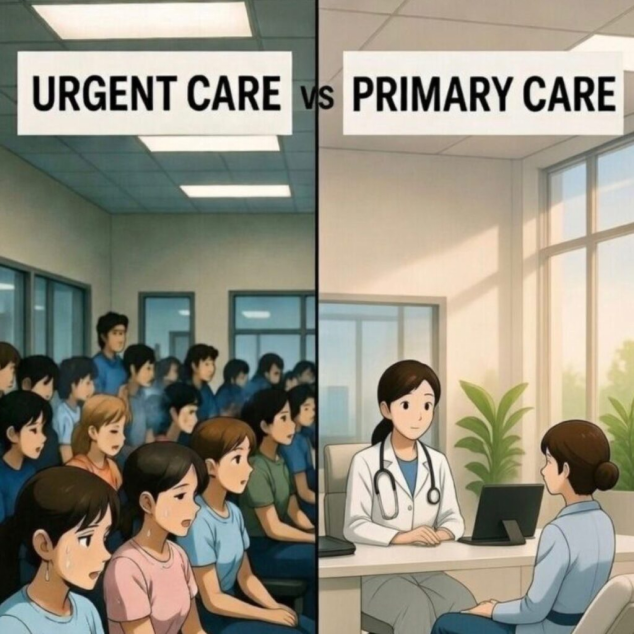
Urgent care is designed for one-time treatment. Primary care is designed for ongoing care.
That distinction matters more than most patients realize. When an urgent care clinician sees you for a sore throat, they treat the sore throat and close the visit. They do not know that you had a similar sore throat three months ago, that your A1C has been creeping up, that you are on a medication that affects your immune system, or that your blood pressure was borderline at your last visit. Your primary care clinician does.
| Urgent care | Primary care at Atrium Medical |
|---|---|
| Designed for one-time episodic treatment. | Designed for ongoing care and follow-up over time. |
| New provider at each visit with no prior context. | Consistent team that knows your history, medications, and labs. |
| Treats the presenting complaint and closes the visit. | Places the complaint in the context of your full clinical picture. |
| Limited ability to track lab trends or coordinate follow-up. | Orders follow-up, tracks results, and coordinates specialist referrals. |
| No prevention, screening, or long-term planning. | Annual physicals, screenings, vaccines, and chronic disease management. |
| Records rarely connect to your long-term care. | One longitudinal medical record, one office, one phone number. |
A common misconception is that urgent care can see you faster for acute problems. For Atrium patients, that is often not true — and for non-Atrium patients, same-day and next-day slots are frequently available.
Conditions that Atrium can evaluate and treat, often same-day:
The difference is not just the visit. It is the follow-up. If your strep culture comes back unusual, if your UTI does not clear, or if the sinus symptoms recur — Atrium has your history and can manage the next step. An urgent care clinic typically does not.
Urgent care is a reasonable option when:
If any of those conditions apply, urgent care is a legitimate option. The issue is that most patients use urgent care as a default even when primary care is faster, better, and available.
Primary care is the better option when:
GO TO THE ER OR CALL 911 FOR ANY OF THE FOLLOWING
Chest pain or pressure
Severe shortness of breath
Stroke symptoms: sudden weakness, facial drooping, slurred speech, vision loss
Severe abdominal pain
Uncontrolled bleeding
Major trauma
Signs of severe allergic reaction or anaphylaxis
Any symptom that feels potentially life-threatening
Neither urgent care nor primary care is the right setting for these symptoms. The emergency room exists for a reason.
New York City has more urgent care clinics per capita than almost any other American city. CityMD alone has dozens of locations in Manhattan. That density, combined with the difficulty of finding same-day primary care appointments at hospital-system practices, created a default behavior: when something is wrong, patients search for the nearest urgent care.
The problem is that urgent care optimizes for throughput, not continuity. A clinician seeing 30 patients in a shift is not building a longitudinal medical relationship with any of them. Prescriptions get written, symptoms get treated, patients leave — and if the problem comes back, they start over.
For patients with recurring sinus infections, unresolved UTIs, unexplained fatigue, chronic blood pressure concerns, or ongoing anxiety — conditions that keep bringing them back to urgent care — primary care is not just better. It is the clinically appropriate setting that the urgent care visit was never designed to provide.
One underappreciated downside of urgent-care-first medicine is antibiotic overuse. Fast-turnaround visits for cough, sore throat, and sinus symptoms create pressure to prescribe, even when antibiotics are unlikely to help. That matters because unnecessary antibiotics do not just fuel resistance — they can also cause significant side effects and may disturb the gut microbiome for years.
Atrium Medical is located at 160 East 56th Street, 12th Floor, in Midtown East, three blocks south of the 59th Street subway hub serving the 4, 5, 6, N, Q, R, and W lines.
Same-day and same-week appointments are frequently available for:
Â
Many follow-up visits, lab reviews, medication check-ins, and non-exam appointments can also be handled by televisit, often same-day.
We accept Aetna, Cigna, Blue Cross Blue Shield, UnitedHealthcare, Oxford, Medicare, and most major commercial insurance plans. See accepted insurance plans.
This is the most common situation for patients who have been relying on urgent care. Either they moved to New York and never established a primary care relationship, or they cycled through a hospital-system practice and gave up on the wait times.
Starting with Atrium does not require a dramatic intake process. Many patients book a new patient visit for a specific problem — a UTI, a sore throat, a blood pressure concern — and that visit becomes the foundation of an ongoing relationship. You do not need to have a list of problems to bring. You just need to show up.
If you are new and have a genuinely urgent same-day issue, call 212-457-1722 and we will find you the right slot.
Cost depends on your specific insurance plan, deductible status, and the services ordered. A few general points:
Atrium does not keep a credit card on file and does not run automatic post-visit charges. See insurance and billing information for details.
Urgent care is a medical clinic for non-emergency problems that need attention quickly. It typically offers walk-in or short-notice visits focused on treating one-time issues. In NYC, CityMD is one of the most recognized urgent care chains.
Primary care is your long-term medical home. It includes preventive care, sick visits, medication management, chronic condition management, and follow-up over time, led by a board-certified internal medicine or family medicine clinician.
Continuity. Urgent care treats the presenting problem and closes the visit. Primary care places that problem in context of your history, tracks your labs and medications over time, and provides follow-up. When symptoms recur or the picture is complex, primary care is the appropriate setting.
Often yes. Many issues treated at urgent care can also be treated at a primary care office, including sore throat, sinus symptoms, cough, UTI symptoms, rashes, mild asthma flares, blood pressure checks, medication refills, STI testing, HIV testing, and PrEP visits.
Not always. Some primary care practices offer same-day availability, online booking, and telehealth that can be as fast or faster than urgent care, especially for established patients. Atrium frequently offers same-day and same-week appointments.
Urgent care is a reasonable option when symptoms are urgent but clearly not life-threatening, it is evening or weekend and your primary care office is closed, or you cannot find a timely appointment elsewhere. It is not the best default for every acute problem, especially for patients who have an established primary care relationship.
Primary care is better when you want continuity and follow-up, when symptoms are recurring or unclear, when you need labs tracked over time, when you want prevention and screening, or when you want coordinated referrals and ongoing management of a chronic condition.
Go to the ER or call 911 for chest pain, severe shortness of breath, stroke symptoms such as sudden weakness or facial drooping, severe abdominal pain, uncontrolled bleeding, major trauma, severe allergic reaction, or any symptom that feels potentially life-threatening. Neither urgent care nor primary care is appropriate for these.
It depends on your plan and deductible. A standard urgent care visit and a primary care office visit are often billed similarly. However, urgent care can generate additional charges from labs, imaging, and repeated visits. Primary care tends to reduce total healthcare cost over time through prevention and better management.

Yes. Antibiotic overprescribing is a documented outpatient problem. CDC estimates that at least 28% of outpatient antibiotic
prescriptions are unnecessary, and 85–95% of all human antibiotic use occurs in outpatient settings.
That matters not only because of antibiotic resistance, but because antibiotics can cause real side effects—including diarrhea, yeast infections, and C. diff. A 2026 Nature Medicine study of 14,979 adults found that some antibiotic-related changes in the gut microbiome were still detectable 4–8 years later. Source: Nature Medicine (2026)
Many common urgent care complaints — sore throat, cough, sinus symptoms, viral upper respiratory infections — do not automatically need antibiotics. Primary care is often the better setting when the diagnosis is unclear, recurring, or likely to need follow-up, because the clinician can examine the whole pattern, review your history, order testing when appropriate, and avoid treating every infection-like symptom with the default assumption that an antibiotic is needed.

No. Atrium Medical is an independent internal medicine primary care practice in Midtown Manhattan. We can often see patients same-day or same-week for many issues people commonly take to urgent care, while providing the continuity and follow-up that urgent care cannot.
For many common acute concerns, yes — including UTI symptoms, sore throat and strep evaluation, sinus symptoms, cough, rashes, pink eye, blood pressure concerns, STI testing, and PrEP visits. Call 212-457-1722 or book online.
Yes. Many Atrium patients start with an acute issue — a UTI, a sore throat, a rash — and that becomes the foundation of an ongoing primary care relationship. You can book a new patient visit or call the office and we will find the right slot for your situation.
This page was reviewed by Atrium Medical Primary Care. Sources may be updated as guidelines change.
For most common acute concerns, you do not have to choose between fast care and good care. Atrium Medical offers same-day and same-week appointments for many of the issues that bring New Yorkers to urgent care — with the added benefit of a clinician who will still know your name next time.
Atrium Medical is located at 160 East 56th Street, 12th Floor, in Midtown East, three blocks from the 59th Street subway hub. Book online or call 212-457-1722.
Someone from our office will contact you as soon as possible. For immediate assistance during regular office hours, please call +1 212-4571722 and select the correct prompt. If this is a medical emergency, please call 911 or visit the nearest hospital.