
PERIMENOPAUSE AND HORMONE THERAPY | MIDTOWN MANHATTAN, NEW YORK CITY
Perimenopause in NYC: You Are Not Imagining It, and There Is a Clinical Answer
Published by: Dr. Shilpa Paradkar Singh, MD | Board-certified Internist and Founder
Last Updated: October 7, 2026

- Full Hormonal Panel
Estrogen, progesterone, testosterone, all in context.
- Insurance Accepted
Most major plans. No $900 cash-pay consult required.
- Physician-Led Treatment
Managed by our clinicians – not an algorithm or a questionnaire.
- Complete Differential
Hormones, thyroid, metabolic health evaluated together.
Fast answer
Atrium Medical provides perimenopause evaluation and physician-managed hormone therapy at 160 East 56th Street in Midtown Manhattan. Dr. Shilpa Paradkar Singh, MD, a board-certified internist, evaluates symptoms alongside estrogen, progesterone, testosterone, thyroid, metabolic health, and cardiovascular risk. Most major insurance plans are accepted for evaluation and testing, including Aetna, Blue Cross Blue Shield, Cigna, UnitedHealthcare, Oxford, and Medicare.
In October 2026, the American College of Physicians issued a strong, high-certainty recommendation that hormone therapy be used as first-line treatment for women seeking treatment for menopausal vasomotor symptoms: estrogen plus a progestogen for women with a uterus, and estrogen alone for women without one.
Sleep disruption, night sweats, mood changes, irregular periods, brain fog, and temperature changes can all occur even when a single hormone panel looks “normal.”
Not sure where your symptoms fit? Try Atrium’s Perimenopause Clinical Navigator.
On This Page
- You were not imagining it: what perimenopause actually is
- Where do you start with perimenopause in New York City?
- The WHI study: what actually happened and why it still matters
- What perimenopause feels like: the full symptom picture
- How hormones are measured -- and why a single blood draw misleads
- The treatment landscape: estrogen, progesterone, testosterone, and the delivery route question
- Why starting earlier matters: the timing argument
- Why in-office physician-led care beats the DTC model
- What patients report: life on the other side of treatment
- Perimenopause and hormone therapy near Midtown East
- Perimenopause and hormone therapy FAQ
You were not imagining it: what perimenopause actually is
For more than 20 years, many women were taught to fear hormone therapy. After the Women’s Health Initiative results were announced in 2002, the message that reached patients was simple and terrifying: hormones cause breast cancer, heart attacks, and strokes.
That was not the whole truth. The study mattered, but the public interpretation was too broad. It turned one trial, in older postmenopausal women using specific oral synthetic hormones, into a warning that shaped care for women who were much younger, newly symptomatic, and often in a completely different clinical situation.
The formal correction came late. In November 2025, FDA and HHS began removing boxed-warning language about cardiovascular disease, breast cancer, and probable dementia from many menopausal hormone therapy products. By 2026, the public conversation had finally started to catch up to what menopause specialists had been saying for years: timing, formulation, delivery route, uterine status, family history, and cardiovascular risk all matter.
That matters because a generation of women lost time. They were told to tolerate symptoms, wait for menopause, try therapy, take an SSRI, or come back when their labs looked worse. Many were never given a real conversation about what was happening hormonally.
So let’s start there.
You are sleeping badly, not just from stress and not just from too much coffee. You wake at 2 or 3am with a clarity that feels almost chemical, lie there for an hour, then drag through the next day. Your periods have changed. Your mood has a quality you cannot name, somewhere between irritability and dread, and it does not match anything happening in your actual life. You feel warm in rooms other people find comfortable. Words leave you mid-sentence. You feel less like yourself than you have in years.
You may have already had bloodwork. You may have been told everything is normal. You may have been told you are too young for menopause, that this is anxiety, that you should try therapy or an SSRI, or that you should come back when your FSH is elevated.
Sometimes stress is part of the picture. Sometimes anxiety is real. Sometimes thyroid, sleep, iron, medication effects, or metabolic health are involved. But for many women, the missing piece is perimenopause.
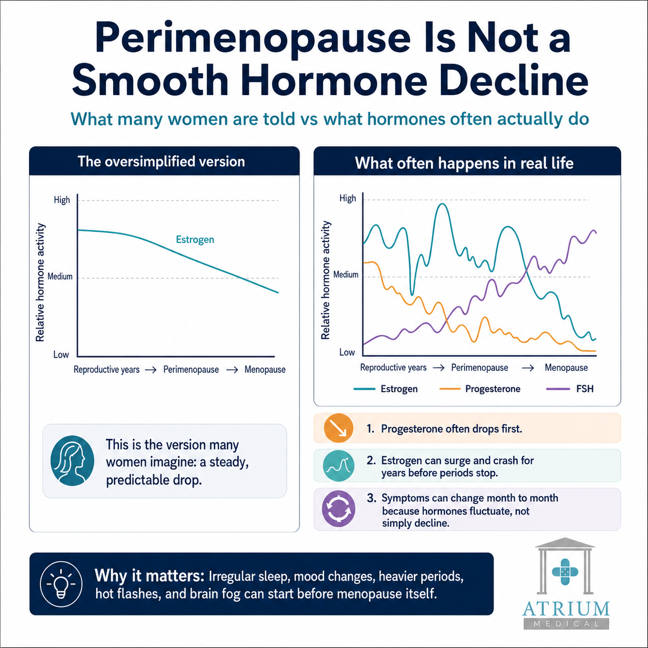
Perimenopause is not simply “early menopause.” It is a hormone fluctuation state. The ovaries do not reduce estrogen output in a neat, predictable line. They become erratic. Estrogen can surge, crash, normalize, and surge again. A blood draw on Tuesday may show normal estradiol because it peaked the prior week and may crash again the following week.
Progesterone often drops earlier than estrogen, sometimes years before estrogen falls consistently. That matters because progesterone has calming and sleep-supporting effects through GABA-A receptor activity. The anxiety, the 3am waking, the emotional reactivity, and the sense that your nervous system has changed can show up before the classic hot flashes do.
The SWAN study, which followed 3,302 women across multiple ethnic groups, documented that hormonal changes can begin years before the final menstrual period. FSH rises and inhibin B falls roughly five years before menopause, and the transition itself commonly spans four to eight years. NICE guidance also states that in women over 45 with typical symptoms, FSH should not be used as the primary diagnostic tool because hormone levels fluctuate during perimenopause.
Perimenopause is real. It is treatable. And in 2026, the evidence base is much clearer than the message most women received from the early 2000s. The question is no longer whether women should simply endure it. The question is whether anyone has taken the time to evaluate the full clinical picture.
Where do you start with perimenopause in New York City?
This is the question many women cannot answer. The healthcare landscape in Manhattan makes a genuinely common condition unnecessarily hard to address.
| Where women turn | What they find | The problem |
|---|---|---|
| Ob-gyn | Pap smears, birth control, pelvic anatomy, obstetrics | Perimenopause management -- hormonal prescribing, thyroid evaluation, cardiovascular risk stratification, metabolic monitoring over years -- is not the center of most ob-gyn practices. Many refer out. |
| Dedicated menopause specialist | NAMS-certified expertise, deep hormonal focus | New patient wait: 3 to 6 months. Initial consultation: $900 or more, cash pay. Most dedicated menopause specialists in NYC do not take insurance. Right destination for complex cases, wrong starting point for a 44-year-old who wants to understand what is happening. |
| Endocrinologist | Thyroid, diabetes, pituitary disorders | Perimenopause is not their primary scope. Requires a referral order, then another 3 to 4 month wait. Will manage thyroid if that is the issue, but not the hormonal transition itself. |
| DTC telehealth platform (Midi, Allara, Evernow, Gennev, Winona) |
Fast prescription delivery, accessible pricing | Can get a prescription to you in 48 hours. Cannot examine you, evaluate your uterus before prescribing estrogen, assess cardiovascular risk to determine safe delivery route, or manage your full metabolic picture alongside the hormones. The prescription is easy. The clinical judgment requires a physician who can actually see you. |
| Primary care internist | Full metabolic picture, insurance accepted, ongoing relationship | Where most women should start and almost never do. An internist manages thyroid, cardiovascular risk, metabolic health, bone density, medication interactions, and hormone therapy in one relationship. For most healthy perimenopausal women, primary care is not a stepping stone to a specialist. It is the right clinical home for this transition. |
The conversation most women are missing is not with a gynecologist, an endocrinologist, or a telehealth platform. It is with a primary care physician who has time to take the full history, run the right panel, and treat the whole person — not just the symptom that got flagged on a questionnaire. Atrium Medical is that practice in Midtown Manhattan. We accept most major insurance plans and are currently accepting new patients.
The WHI study: what actually happened and why it still matters
Every woman reading this page has either heard about the Women’s Health Initiative study or has a physician whose prescribing habits were shaped by it. The story is worth telling clearly, because it directly explains why so many women have been undertreated for so long.
The Women’s Health Initiative (WHI) was a massive federally funded study launched in the 1990s. Its hormone therapy arm enrolled women aged 50 to 79 — mean age 63.2 years, meaning most participants were more than a decade past menopause. The trial used oral conjugated equine estrogen (CEE) plus synthetic medroxyprogesterone acetate (MPA): not bioidentical hormones, not transdermal delivery. On July 9, 2002, the NIH held a press conference and announced it was stopping the estrogen-plus-progestin arm early, citing increased rates of breast cancer, blood clots, stroke, and heart disease.
HRT prescriptions in the US fell by more than 60 percent within months. Women already on therapy were told to stop overnight. A 2013 analysis estimated that between 2002 and 2012, as many as 91,000 postmenopausal women in the US died prematurely from conditions that estrogen therapy might have helped prevent.
Five critical problems with how the WHI was applied to perimenopausal women
| Problem | Why it matters |
|---|---|
| Wrong age group | Average participant was 63 -- more than a decade past menopause. Starting hormone therapy more than 10 years after menopause carries a different risk-benefit profile than starting during the perimenopausal transition. The findings were applied to women 20 years younger. |
| Wrong formulation | The trial used oral CEE (conjugated equine estrogen) and MPA (synthetic medroxyprogesterone acetate). The breast cancer signal was largely driven by MPA -- not micronized progesterone, which is standard of care today. These are not interchangeable. |
| Wrong delivery route | Oral estrogen undergoes first-pass liver metabolism, raising clotting factors and triglycerides. Transdermal estradiol at a 50 mcg/day equivalent does not increase stroke risk above background (Mukherjee et al., Clinical Endocrinology, 2025). The clotting and stroke signals were largely an oral estrogen phenomenon. |
| The timing hypothesis was missed | Women who initiate hormone therapy within 10 years of menopause onset or before age 60 have a substantially different risk-benefit profile. This is now confirmed across multiple datasets and is called the 'window of opportunity.' |
| The wrong conclusion was drawn and broadcast | A press conference, not a peer-reviewed synthesis, communicated the findings. The relative risks were reported as if they applied to all women on any hormone therapy. A generation of physicians and patients acted on that misrepresentation. |
In November 2025, the FDA and HHS announced the removal of the black box warning on HRT products for cardiovascular disease and breast cancer, describing the original warning language as misleading.
FDA/HHS, November 2025
The WHI study was not wrong about what it measured. The problem was what medicine did with it afterward. A study of older postmenopausal women on one oral synthetic regimen became a reason to withhold a conversation from younger symptomatic women in a different clinical situation.
That overcorrection lasted more than two decades. For many women, the correction is finally arriving now.
What perimenopause feels like: the full symptom picture
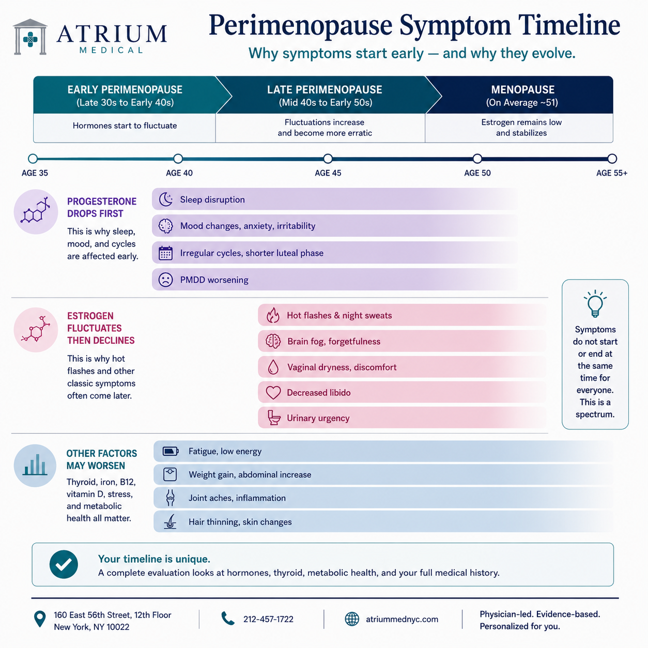
The symptom picture of perimenopause is wider than most women are told, and it unfolds over years in a sequence that does not always follow the textbook order. Symptoms appear because different hormone changes happen at different times — progesterone drops first, estrogen fluctuates before it falls consistently, and testosterone declines gradually across the transition.
| Symptom domain | What is happening biologically | Why it gets missed |
|---|---|---|
| Sleep disruption -- waking at 2-4am, unrested despite adequate hours |
Progesterone is a GABA-A receptor modulator with direct sleep-promoting effects. Its decline begins in early perimenopause, before estrogen falls significantly. | Often attributed to stress or anxiety. SSRI prescribed instead of progesterone. |
| Mood changes -- irritability, emotional reactivity, low-grade anxiety or dread |
Estrogen modulates serotonin, dopamine, and norepinephrine. Progesterone modulates GABA. Both affect mood architecture. | Diagnosed as anxiety or depression. Psychiatric treatment started without hormonal evaluation. |
| Vasomotor symptoms -- hot flashes, night sweats |
Estrogen withdrawal destabilizes the hypothalamic thermostat. The thermoneutral zone narrows. Affects 48 to 79 percent of perimenopausal women (PMID: 41725550). | Often the most recognized symptom -- but frequently not the first. |
| Cognitive fog -- word retrieval difficulty, processing speed, concentration |
Estrogen receptors are present throughout the brain. Hormonal fluctuation affects neurotransmitter systems and cerebral blood flow (Maki and Jaff, Menopause, 2024). | Dismissed as overwork or aging. Not investigated as a hormonal symptom. |
| Cycle changes -- irregular periods, heavier bleeding, shorter cycles |
Estrogen surges cause heavier proliferative bleeding. Progesterone insufficiency removes the counterbalance. | Often attributed to stress or fibroids without hormonal evaluation. |
| Genitourinary symptoms -- vaginal dryness, dyspareunia, urinary urgency |
Estrogen receptor loss in urogenital tissue. Highly responsive to local estrogen therapy even when systemic therapy is not used. | Embarrassment prevents reporting. Treated as UTI or aging. |
| Body composition shifts -- central fat accumulation, loss of lean mass |
Estrogen promotes peripheral fat storage over visceral fat. Its decline shifts this distribution. Insulin sensitivity decreases. | Told to eat less and exercise more. The hormonal environment change is not addressed. |
| Low libido and reduced sexual function | Both estrogen and testosterone pathways involved. Testosterone declines across perimenopause and directly affects arousal and desire. | Often attributed to relationship or psychological factors. Testosterone not evaluated. |
How hormones are measured -- and why a single blood draw misleads
The diagnostic challenge of perimenopause is not just that symptoms are vague. It is that the standard diagnostic tool — a blood draw — is poorly suited to a condition defined by hormone fluctuation rather than consistent hormone deficiency.
During perimenopause, estrogen and FSH can appear entirely within normal range on the day blood is drawn, because levels may have peaked the prior week and will shift again the following week. NICE (2023) and most major guidelines explicitly state: in women over 45 with classic perimenopausal symptoms, clinical diagnosis is appropriate without waiting for lab values to fall outside the reference range. A woman with sleep disruption, irregular cycles, mood changes, and night sweats at age 46 does not need to wait until her FSH hits a specific threshold before discussing treatment.
What a complete perimenopausal evaluation at Atrium includes
| Test | What it measures | Why it matters in perimenopause |
|---|---|---|
| Estradiol (E2) | Primary estrogen; fluctuates erratically in perimenopause | A single normal reading does not rule out perimenopausal fluctuation -- context and symptoms matter more than a snapshot |
| FSH (Follicle-Stimulating Hormone) | Pituitary signal to ovaries; rises as ovarian response declines | Useful directionally but highly variable day-to-day; not reliable as a standalone diagnostic in women over 45 |
| Progesterone (luteal phase timed) | Key for sleep, mood, cycle regulation; drops first in perimenopause | Often the most clinically relevant hormone in early perimenopause -- rarely checked |
| Total and free testosterone | Sexual function, libido, energy, muscle mass, mood | Declines across perimenopause; often overlooked in women's hormonal evaluation |
| SHBG (Sex Hormone-Binding Globulin) | Binds testosterone and estrogen; affects bioavailability | Needed to calculate free testosterone accurately |
| LH (Luteinizing Hormone) | Pituitary output; rises with FSH in perimenopause | Useful to contextualize FSH reading |
| TSH (Thyroid) | Thyroid function -- essential differential | Hypothyroidism, Hashimoto's, and perimenopause have overlapping symptoms; TSH is mandatory before attributing symptoms to hormones alone |
| CBC (Complete Blood Count) | Anemia screen | Fatigue and cognitive symptoms attributed to perimenopause may be anemia -- must be ruled out |
| Metabolic panel, lipids, glucose, A1c | Metabolic baseline | Estrogen affects lipid metabolism and insulin sensitivity; baseline required before and during therapy |
| Vitamin D | Bone health, immune function, mood | Deficiency common and contributes to fatigue and mood symptoms that overlap with perimenopause |
A note on DTC lab panels: Function Health, Midi Health, and similar platforms offer hormone panels as part of broader biomarker packages. A result in a dashboard is not a diagnosis. Without a physician who examines you, reviews your full symptom history, evaluates the thyroid, assesses uterine status before prescribing estrogen, and interprets results in clinical context — a number is a starting point, not a treatment plan. Atrium helps patients who arrive with DTC results understand what those numbers actually mean.
The treatment landscape: estrogen, progesterone, testosterone, and the delivery route question
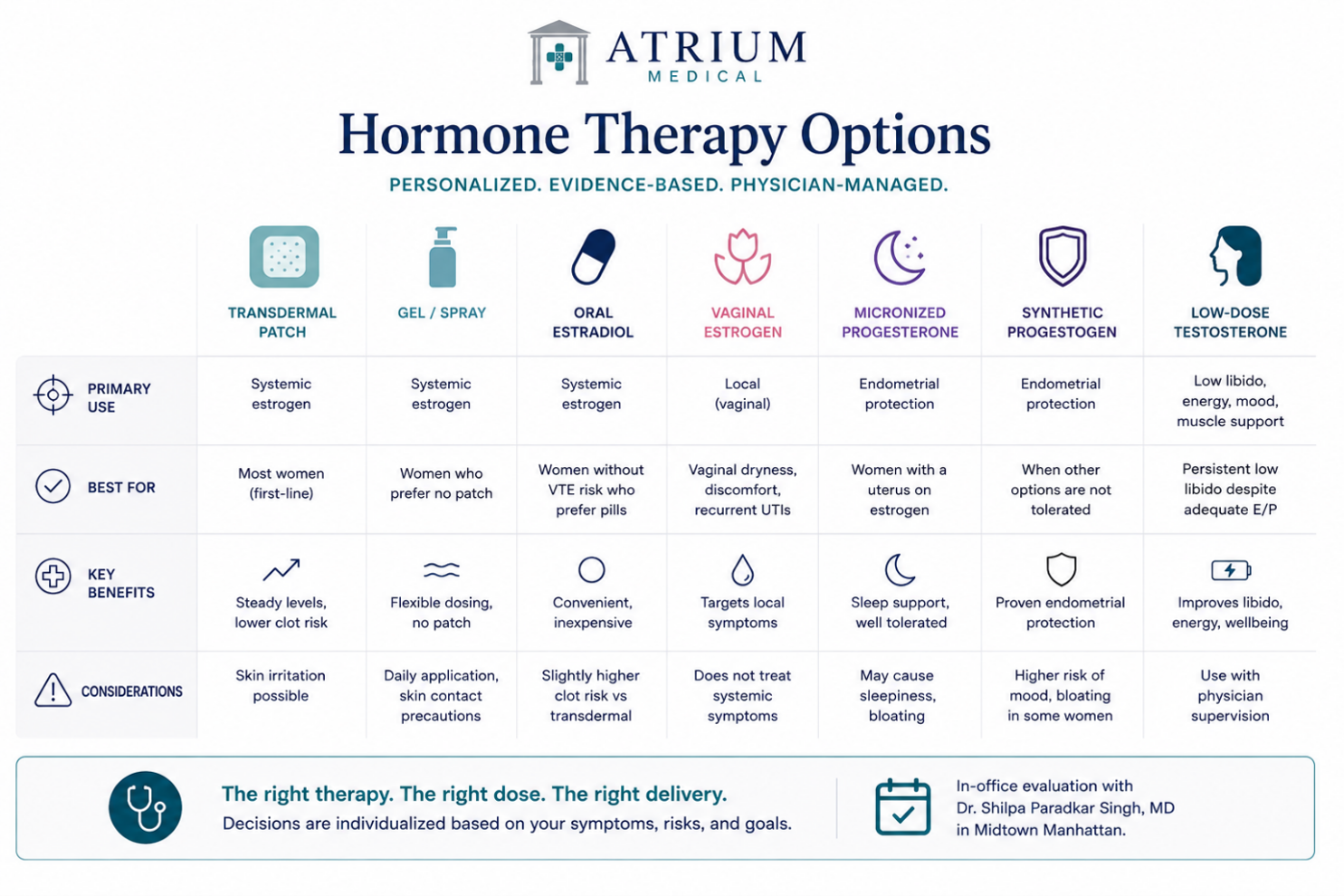
Treatment is not a menu. It is a clinical decision based on your symptoms, lab pattern, medical and family history, cardiovascular risk factors, uterine status, fertility goals if relevant, and lifestyle. What follows is the evidence landscape as it exists in 2026.
Estrogen
The cornerstone of hormone therapy for perimenopausal symptoms. FDA-approved for vasomotor symptoms, genitourinary symptoms, and osteoporosis prevention. The delivery route matters enormously — this is where the WHI findings most mislead.
| Delivery route | How it works | Key consideration |
|---|---|---|
| Transdermal patch (Climara, Vivelle-Dot) |
Estradiol absorbed through skin directly into bloodstream, bypassing liver | Preferred for women with cardiovascular risk, migraine, stroke risk, or elevated triglycerides. Avoids first-pass liver metabolism. Does not increase clotting risk at therapeutic doses. |
| Transdermal gel or spray (Divigel, Estrogel, Evamist) |
Daily application; flexible dosing | Same advantages as patch; some women prefer the spray or gel format. Dose flexibility. |
| Oral estradiol (Estrace) |
Convenient daily pill; undergoes first-pass liver metabolism | Not preferred for women with cardiovascular risk. Raises clotting factors and triglycerides. The delivery route associated with most of the WHI stroke/clot signals. |
| Vaginal estrogen (Estrace cream, Estring ring, Vagifem/Yuvafem tablets) |
Local delivery to urogenital tissue | Minimal systemic absorption. Highly effective for genitourinary symptoms. Can be used in women who decline or cannot use systemic therapy including many with breast cancer history. |
Progesterone
Required in women with an intact uterus to prevent endometrial hyperplasia from unopposed estrogen. The distinction between bioidentical micronized progesterone and synthetic progestogens is clinically important and often poorly explained to patients.
| Option | Type | Key difference |
|---|---|---|
| Micronized progesterone (Prometrium) |
Bioidentical -- same molecule as endogenous progesterone | Preferred option. More favorable breast tissue profile than synthetic progestogens. Sleep-promoting effects via GABA-A modulation. The breast cancer signal from the WHI was driven by MPA, not micronized progesterone. |
| Synthetic progestogens (MPA, norethindrone, levonorgestrel) |
Synthetic -- different receptor binding than progesterone | Used in many combined HRT products and hormonal IUDs. Higher breast tissue stimulation. Not equivalent to micronized progesterone in risk profile. |
| Levonorgestrel IUD (Mirena) |
Local progestogen delivery to uterus | Minimal systemic progestogen. Can be used as uterine protection alongside systemic estrogen in some patients. Requires gynecological placement. |
Testosterone
No FDA-approved testosterone product exists for women in the US — a regulatory gap that does not reflect the science. The International Society for the Study of Women’s Sexual Health (ISSWSH) and the Endocrine Society both endorse low-dose testosterone therapy for postmenopausal women with hypoactive sexual desire disorder (HSDD). Evidence for sexual function is robust. Evidence for mood, energy, and muscle maintenance in perimenopausal women is accumulating.
Off-label options in the US include low-dose compounded testosterone cream or gel and male formulations at female-appropriate doses (typically 1/10th of male doses or less). The PMC9331845 review (2022) documents safety data spanning 80 years of testosterone use in women and notes two large long-term studies showing a significant reduction in invasive breast cancer incidence in women on testosterone therapy. Atrium evaluates testosterone as part of a complete hormonal assessment and prescribes where clinically indicated.
The bioidentical versus synthetic and compounded distinction
Bioidentical hormones have the same molecular structure as hormones produced by the human body. FDA-approved bioidentical options — 17-beta estradiol (Estrace, Climara, Divigel) and micronized progesterone (Prometrium) — are the standard of care in most current guidelines.
Custom-compounded bioidentical hormones from compounding pharmacies are a different category. Their hormone concentrations are not standardized, their absorption is not validated in rigorous clinical trials, and they have not undergone the safety testing of FDA-approved products. Atrium prescribes FDA-approved bioidentical therapy, not custom-compounded preparations. If you have been told that compounded hormones are safer or more natural than FDA-approved bioidenticals, that is not supported by evidence.
Why starting earlier matters: the timing argument
This is the clinical point most women were never given clearly: when hormone therapy starts can be as important as which hormone is used.
For years, the conversation was framed as if hormone therapy had one risk profile. It does not. Starting hormone therapy during the perimenopausal transition or early menopause is not the same clinical decision as starting it for the first time decades later. The patient is different, the arteries are different, the baseline risk is different, and the goal of treatment is different.
A 2025 large-scale retrospective analysis presented through The Menopause Society reported that women who started estrogen therapy during perimenopause had substantially lower rates of breast cancer, heart attack, and stroke compared with women who started after menopause or did not use estrogen therapy. That does not mean every woman should be placed on estrogen. It means timing belongs at the center of the risk-benefit discussion, instead of being treated as a footnote.
A separate 2024 study in Menopause looked at hormone therapy use beyond age 65 using Medicare data from 2007 to 2020. The strongest signal was seen with estrogen monotherapy, which was associated with a 19 percent lower risk of all-cause mortality and lower risks for several outcomes, including breast cancer, lung cancer, colorectal cancer, congestive heart failure, atrial fibrillation, acute myocardial infarction, and dementia. That study does not turn estrogen into a blanket prevention drug, but it does further weaken the old idea that hormone therapy automatically becomes dangerous after a certain birthday.
The cardiovascular argument is about timing and vessel health. Estrogen helps maintain endothelial function, vascular tone, lipid handling, and inflammatory signaling. Earlier in the transition, those effects may support a healthier vascular environment. Later, when plaque and vascular disease are already established, the same therapy enters a different biological landscape. That is why a healthy symptomatic 46-year-old and a 68-year-old starting hormones for the first time are not the same patient.
The bone argument is more direct. Estrogen is one of the main protectors of bone density in women, and bone loss accelerates around the menopausal transition. This is silent. A woman does not feel her bone density falling. She feels fine until a DEXA scan years later shows osteopenia or osteoporosis that may have been developing for a decade.
The brain argument is promising, but still unsettled. Estrogen receptors are present throughout the brain, and many women notice changes in word retrieval, processing speed, sleep, and mood during perimenopause. Observational studies suggest timing may matter for later cognitive outcomes, but this is not the same as saying hormone therapy prevents Alzheimer’s disease. The honest conclusion is better: the brain is part of the menopause story, and it should not be dismissed.
For a symptomatic woman in her early-to-mid 40s, waiting five more years is not automatically the conservative choice. Sometimes it is just delayed care. The right answer is not reflexively starting hormones and not reflexively avoiding them. The right answer is an individualized evaluation while the window is still open.
Why in-office physician-led care beats the DTC mode
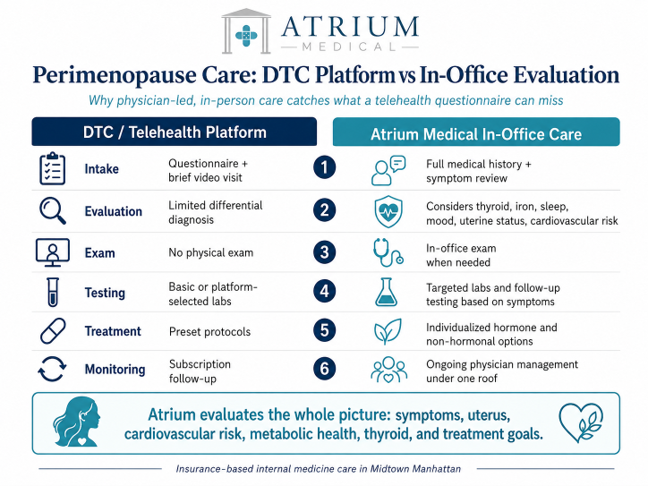
The DTC perimenopause market grew because it met a real need. Women were symptomatic, dismissed, and tired of being told to wait months for a specialist or pay cash for a menopause consult. Platforms like Midi, Allara, Evernow, Gennev, Winona, and others made hormone therapy easier to access, and that access has value.
But access is not the same thing as a complete medical evaluation.
Perimenopause is not just an estrogen problem. It sits at the intersection of hormones, thyroid function, sleep, mood, cardiovascular risk, metabolism, uterine status, sexual health, bone density, and family history. A woman may need estrogen. She may need progesterone. She may need vaginal estrogen only. She may need testosterone considered carefully. She may need thyroid treatment, anemia workup, metabolic intervention, blood pressure control, or a gynecologic evaluation before systemic hormones are even discussed.
A questionnaire can collect symptoms. It can route a patient into a protocol. It can get a prescription moving quickly. What it cannot do is examine you, check blood pressure in context, evaluate abnormal bleeding, assess whether your uterus needs protection before estrogen, feel a thyroid gland that is enlarged or nodular, or decide whether oral estrogen or transdermal estradiol makes more sense for your cardiovascular risk profile.
That distinction is not academic. A woman with an intact uterus who receives systemic estrogen without adequate progesterone protection is not getting careful hormone care. A woman with migraines, elevated triglycerides, clotting history, uncontrolled blood pressure, or strong cardiovascular risk factors may need a different estrogen route than a questionnaire would choose. A woman with fatigue, weight gain, cold intolerance, hair thinning, irregular cycles, and brain fog may have perimenopause, thyroid disease, iron deficiency, or more than one thing happening at once.
Atrium’s model is built around the full picture. We evaluate symptoms, history, exam findings, hormone patterns, thyroid function, metabolic health, uterine status, cardiovascular risk, and medication history before deciding what belongs in the treatment plan. Sometimes the answer is hormone therapy. Sometimes it is a different diagnosis. Often, it is a plan that handles several problems together.
The prescription is only one part of the work. The clinical judgment is the care.
What patients report: life on the other side of treatment
Clinical trials measure hormone therapy in symptom scores, hot-flash frequency, sleep scales, quality-of-life measures, bone density, and metabolic outcomes. Patients usually describe the change more plainly.
The first thing many women notice is sleep. Not perfect sleep, and not a dramatic overnight transformation, but the return of a rhythm that had disappeared. The 3am waking becomes less frequent. The hour of lying awake shortens. Mornings feel less punishing. Many women say they did not realize how much of their personality had been spent compensating for poor sleep until the sleep started coming back.
Mood is often the next change people around them notice. The irritability that felt chemical, the dread that did not match the facts of their life, the feeling of being constantly overstimulated or one comment away from tears, all of that can soften when the hormone pattern is treated correctly. This does not mean every mood symptom is hormonal. It means perimenopause can put a real biological load on the nervous system, and treating that load can make a woman feel more like herself again.
Hot flashes and night sweats usually improve over weeks once estrogen therapy is matched to the patient and delivered through the right route. As nighttime temperature swings settle, sleep often improves further. That combination is powerful because the symptoms feed each other: poor sleep worsens mood, poor mood worsens coping, and both make the body feel older than it is.
Cognitive symptoms tend to lift more gradually. Women describe it as getting their words back, getting their processing speed back, or no longer feeling like they are watching themselves perform at 70 percent. The change is often subtle at first, but it matters enormously to women who work, lead teams, parent, manage households, and know exactly how their brain used to feel.
Body composition takes longer. Hormone therapy does not replace strength training, protein, sleep, glucose control, or consistency. What it can do, in the right patient, is improve the hormonal environment in which those efforts happen. Many women describe the same behavior finally producing results again. The gym still has to happen. The difference is that the body stops feeling like it is ignoring the work.
Good hormone therapy is not a promise that a woman will feel 35 again. It is not a cure for every symptom, and it is not a substitute for sleep, exercise, nutrition, mental health care, or preventive medicine. It is a way to correct a real hormonal transition that affects sleep, mood, temperature regulation, sexual health, urinary symptoms, bone density, metabolism, and quality of life.
For many women, the biggest change is not one symptom. It is the feeling that the story finally makes sense
Perimenopause and hormone therapy near Midtown East
Atrium Medical is located at 160 East 56th Street, 12th Floor, in Midtown East Manhattan, close to the Plaza District, Sutton Place, Park Avenue, Lexington Avenue, Grand Central, Rockefeller Center, and the Upper East Side.
That location matters because women in New York do not need another healthcare errand that consumes half a day. Perimenopause evaluation often involves labs, a detailed history, medication review, blood pressure, metabolic screening, thyroid evaluation, and a real conversation about symptoms that may have been brushed aside for years. Doing that inside a primary care practice near work makes the whole process easier to start and easier to continue.
Atrium is a short walk from the 59th Street/Lexington Avenue subway hub, with access to the 4, 5, 6, N, R, and W trains, and is also convenient to the E and M trains at 53rd Street. For Midtown professionals, the practical version is simple: come in for a morning lab draw or hormone evaluation before work, then get back to your desk without losing half the day.
Most major insurance plans are accepted for evaluation and testing, including Aetna, Blue Cross Blue Shield, Cigna, UnitedHealthcare, Oxford, and Medicare. Coverage for hormone therapy itself varies by medication, formulation, pharmacy benefit, and plan design.
This is the advantage of doing perimenopause care inside a real primary care relationship. The same team can evaluate hormones, thyroid, anemia, glucose, A1c, lipids, blood pressure, family history, cardiovascular risk, bone health, sleep, weight changes, and sexual health in one place. That is much harder to do through a one-off cash consult or a subscription platform that only sees the hormone question
Perimenopause and hormone therapy FAQ
Most women do not know where to begin. Dedicated menopause specialists in NYC may have long waits and high cash-pay consult fees. DTC telehealth platforms can prescribe quickly but cannot examine you, evaluate your uterus before prescribing estrogen, or manage your full metabolic picture. A board-certified internist is often the right first call. Atrium manages thyroid, cardiovascular risk, metabolic health, medication interactions, and hormone therapy under one roof. Most major insurance plans are accepted for evaluation and testing, including Aetna, Blue Cross Blue Shield, Cigna, UnitedHealthcare, Oxford, and Medicare.
Probably not. Perimenopause typically begins in the mid-40s but can start in the late 30s. The SWAN study documented FSH changes and hormonal fluctuation beginning roughly five years before the final menstrual period. If you are experiencing sleep disruption, irregular periods, mood changes, night sweats, or cognitive fog in your early to mid-40s, these are real perimenopausal symptoms that warrant clinical evaluation -- not reassurance that your labs are normal.
The concern comes from the 2002 Women’s Health Initiative study, which studied older postmenopausal women on oral synthetic hormones, not the transdermal estradiol and micronized progesterone approach commonly used today. In November 2025, FDA and HHS began updating menopausal hormone therapy labeling, and in February 2026 FDA approved changes removing boxed-warning risk statements about cardiovascular disease, breast cancer, and probable dementia from certain products. The endometrial cancer warning remains where applicable. The point is not that hormone therapy is risk-free. The point is that timing, formulation, delivery route, uterine status, family history, and cardiovascular risk matter enormously.
Bioidentical hormones have the same molecular structure as hormones produced by the human body. 17-beta estradiol and micronized progesterone (Prometrium) are bioidentical and FDA-approved. Conjugated equine estrogen (CEE) and medroxyprogesterone acetate (MPA) -- the hormones used in the WHI study -- are not bioidentical. The breast cancer signal from the WHI was largely driven by MPA, not micronized progesterone. Atrium prescribes FDA-approved bioidentical therapy, not custom compounded preparations.
Not necessarily, but it depends on your symptoms. Testosterone in women declines through the perimenopausal years and plays a role in sexual function, libido, energy, mood, and muscle maintenance. There is no FDA-approved testosterone product for women in the US, but off-label low-dose testosterone therapy is endorsed by ISSWSH and the Endocrine Society for women with hypoactive sexual desire disorder. Atrium evaluates testosterone as part of a complete hormonal assessment.
No. NICE guidelines explicitly state that FSH should not be used as the primary diagnostic tool in women over 45 with perimenopausal symptoms. FSH fluctuates dramatically during perimenopause -- a reading that appears normal on the day of the draw may have been significantly elevated the week before. Clinical diagnosis based on symptoms and history is appropriate for women over 45. Waiting for a specific threshold is not required and may delay treatment unnecessarily.
Yes. Board-certified internists prescribe and manage hormone therapy. An internist has the clinical scope to evaluate the full picture -- thyroid, metabolic health, cardiovascular risk factors, medication interactions, and bone density -- alongside hormonal therapy. For most healthy perimenopausal women, primary care is not a stepping stone to a specialist. It is the right clinical home for this transition.
A complete perimenopausal evaluation includes estradiol, FSH, progesterone (timed to luteal phase if still cycling), total and free testosterone, SHBG, LH, TSH, CBC, complete metabolic panel, lipids, fasting glucose, A1c, and vitamin D. A single estrogen or FSH reading without clinical context is not sufficient to guide treatment decisions.
Hormone therapy is the most effective treatment for vasomotor symptoms (hot flashes and night sweats), sleep disruption, genitourinary symptoms (vaginal dryness, urinary urgency), and mood instability related to hormonal fluctuation. It also protects bone density and has cardiovascular benefits when initiated during the perimenopausal window. It is not a treatment for primary depression or anxiety, though hormonal contributions to mood should always be evaluated before attributing symptoms to a psychiatric diagnosis.
A family history requires individualized risk assessment -- it is not an automatic contraindication. The type of cancer, the relationship of the family member, genetic testing results (BRCA1/2), and the specific hormone formulation all factor into the decision. Some women with family history of breast cancer can safely use hormone therapy with appropriate monitoring; others may be better served by non-hormonal options. This is a clinical conversation, not a checkbox. Atrium takes a complete family and personal history before any prescribing decision.
Sources and clinical references
- Gold EB et al. Longitudinal analysis of changes in hormonal levels through the menopausal transition: SWAN study. Menopause. 2011;18(6):631-639.
- Writing Group for the WHI Investigators. Risks and Benefits of Estrogen Plus Progestin in Healthy Postmenopausal Women. JAMA. 2002;288(3):321-333.
- Lobo RA et al. Reappraising 21 years of the WHI study. Maturitas. 2023;172:11-17.
- Mukherjee S et al. Update on Menopause Hormone Therapy. Clinical Endocrinology. 2025;102(1):1-12.
- Yanachkova V et al. Reconsidering Hormone Replacement Therapy. J Clin Med. 2025;14(20):7156. PMID: 41156026.
- Maki PM, Jaff NG. Menopause and brain fog: how to counsel and treat midlife women. Menopause. 2024;31(7):647-649.
- Hormone Replacement Therapy. StatPearls. NCBI Bookshelf. Updated October 2024.
- Davis SR et al. A Personal Prospective on Testosterone Therapy in Women. PMC9331845. Int J Environ Res Public Health. 2022.
- NICE Menopause: Diagnosis and Management. National Institute for Health and Care Excellence. 2023.
- The 2022 Hormone Therapy Position Statement of the North American Menopause Society. Menopause. 2022;29(7):767-794.
- FDA/HHS: Removal of boxed warning on HRT for cardiovascular disease and breast cancer. November 2025.
- European Society of Endocrinology clinical practice guideline for perimenopause and menopause. Eur J Endocrinol. 2025;193(4):G49.
- Hot flashes and health-related quality of life in perimenopausal women. PMID: 41725550. 2026.
- Atsma F et al. Postmenopausal status and early menopause as independent risk factors for cardiovascular disease. Menopause. 2006.
- When Women Initiate Estrogen Therapy Matters. The Menopause Society. 2025 Annual Meeting press release. Large-scale retrospective cohort analysis of more than 120 million patient records comparing estrogen therapy started during perimenopause, after menopause, or not used.
- Timing of Estrogen Therapy: Peri or Post. The Menopause Society 2025 Annual Meeting poster / press PDF. Reports approximately 60 percent lower odds of breast cancer, heart attack, and stroke in the perimenopause-start group compared with other groups.
- Baik SH, Baye F, McDonald CJ. Use of menopausal hormone therapy beyond age 65 years and its effects on women’s health outcomes by types, routes, and doses. Menopause. 2024;31(5):363-371. PMID: 38595196.
- Qaseem A, Mackey K, Yost J, Shekelle PG, et al. Pharmacologic Treatments for Females With Menopausal Vasomotor Symptoms: A Clinical Guideline From the American College of Physicians. Annals of Internal Medicine. 2026. DOI: 10.7326/ANNALS-26-01205
Ready to have the clinical conversation you have been waiting for?
Not a questionnaire. Not a $900 cash-pay consultation with a three-month wait. A physician who examines you, runs the right panel, knows your full medical history, and manages hormone therapy in the context of your whole health — under most major insurance plans.
Atrium Medical is at 160 East 56th Street, 12th Floor, Midtown East — three blocks south of the 59th Street subway hub on the 4, 5, 6, N, Q, R, and W lines. Book online or call 212-457-1722.