
PrEP & HIV PREVENTION | MIDTOWN MANHATTAN, NEW YORK CITY
PrEP in NYC: HIV Prevention, Testing, Medication Options, and Follow-Up Care
Published by
Dr. Shilpa Paradkar Singh, MD
Last Updated: September 2026

IF YOU MAY HAVE BEEN EXPOSED TO HIV IN THE PAST 72 HOURS — READ THIS FIRST
What you may need is PEP — post-exposure prophylaxis — not PrEP. PEP is emergency medication that must be started within 72 hours of possible exposure. The sooner it starts, the better it works. After 72 hours it is no longer effective.
Call Atrium at 212-457-1722. If we cannot see you immediately, go to an emergency department or an NYC Sexual Health Clinic. Do not wait.
- PrEP Options
Oral and Injectable PrEP
- HIV + STI Testing
Testing and Monitoring
- Insurance Help
Coverage and Pharmacy Support
- Midtown East
160 East 56th Street
Fast answer: what PrEP is and who it is for
PrEP is medication taken by people who do not have HIV to reduce their chance of getting HIV. It can be used by adults and adolescents who may be exposed to HIV through sex or injection drug use. It is not a sign of risk-taking. It is preventive medicine. CDC guidance encourages clinicians to inform sexually active adults about PrEP, not only patients who fit an old stereotype.
At Atrium Medical in Midtown Manhattan, we treat PrEP as part of serious primary care. That means we help patients understand daily oral options such as generic Truvada and Descovy, long-acting injectable options such as APRETUDE, the twice-yearly lenacapavir option marketed as Yeztugo, and the lab and insurance pathway that keeps prevention safe and sustainable.
Atrium Medical is located at 160 East 56th Street, 12th Floor, near the 59th Street subway hub and Grand Central. To schedule a PrEP consultation, book online, check insurance, or call 212-457-1722.
The right PrEP option depends on HIV testing, exposure type, kidney function, hepatitis B status, side effects, privacy, insurance coverage, and follow-up logistics. Your Atrium clinician can discuss all these with you at your visit.
| Patient need or situation | Option to discuss |
|---|---|
| Lowest-cost established oral option | Generic Truvada / TDF-FTC |
| Kidney or bone concerns in eligible exposure groups | Descovy / TAF-FTC |
| Trouble taking a daily pill or pill fatigue | APRETUDE / cabotegravir injection every 2 months |
| Wants twice-yearly prevention and meets clinical/access criteria | Yeztugo / lenacapavir injection every 6 months after initiation |
| Possible HIV exposure in the past 72 hours | PEP, not PrEP. Call immediately or go to an ER/NYC Sexual Health Clinic. |
On This Page
- PrEP vs PEP: what to do based on timing
- Verified PrEP access in Midtown Manhattan
- PrEP is no longer just a daily pill
- PrEP options compared: Truvada, Descovy, APRETUDE, and lenacapavir
- Side effects and monitoring by medication
- How long does PrEP take to start working?
- What happens at your first Atrium PrEP visit
- Who should consider PrEP?
- The PrEP lab and monitoring lifecycle
- HIV testing before and during PrEP
- Acute HIV symptoms: when to get urgent evaluation before starting PrEP
- STI screening, doxy-PEP, and vaccines
- 2-1-1 on-demand PrEP
- Truvada vs Descovy: not just a brand choice
- Long-acting injectable PrEP: APRETUDE and lenacapavir
- PrEP for women, pregnancy, and conception planning
- Stopping or pausing PrEP
- Continuing PrEP started elsewhere
- Privacy, insurance, and explanation-of-benefits concerns
- Cost, insurance, PrEP-AP, and co-pay help in New York
- Why PrEP belongs in primary care
- PrEP FAQ
PrEP vs PEP: what to do based on timing
NEED HIV PREVENTION AFTER A POSSIBLE EXPOSURE? USE THIS TO DECIDE
Exposure within the past 72 hours: call immediately about PEP. Do not start PrEP. PEP must be started within 72 hours to be effective. Go to an emergency room or NYC Sexual Health Clinic if you cannot reach Atrium.
No recent exposure but ongoing future risk: PrEP may be appropriate. Schedule an evaluation.
Symptoms of acute HIV (fever, rash, sore throat, swollen lymph nodes, body aches, night sweats) after recent high-risk exposure: urgent HIV testing and clinical guidance are needed before starting anything.
Exposure more than 72 hours ago: PEP is no longer effective. PrEP evaluation may be the right next step.
PrEP prevents future HIV exposure. PEP treats a possible past exposure. They are different medications on different timelines. Confusing them can mean missing the window when emergency prevention still works.
Verified PrEP access in Midtown Manhattan
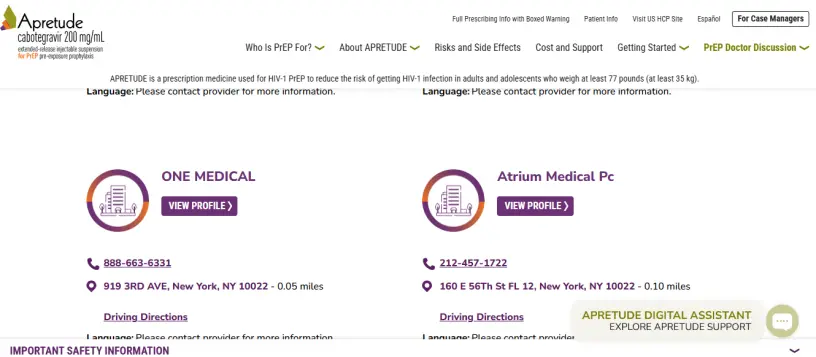
Atrium Medical is not just publishing generic PrEP content. Atrium is listed in external PrEP access infrastructure that patients, search engines, and clinical directories use to connect real people with real providers.
Atrium Medical appears in the official APRETUDE PrEP provider locator and in the New York State Department of Health AIDS Institute PrEP/PEP Voluntary Provider Directory. Patients can verify Atrium by searching the directories for ZIP code 10022 or for Dr. Shilpa Paradkar Singh where provider-name search is available.
Atrium Medical is also listed in the CDC National Prevention Information Network (NPIN) directory at 160 East 56th Street, 12th Floor, New York, NY 10022. The CDC NPIN listing includes HIV and STI testing services, PrEP, PEP, Doxy PEP, hepatitis and HPV vaccines, STI treatment, insurance accepted, and PrEP navigation.
PrEP is no longer just a daily pill
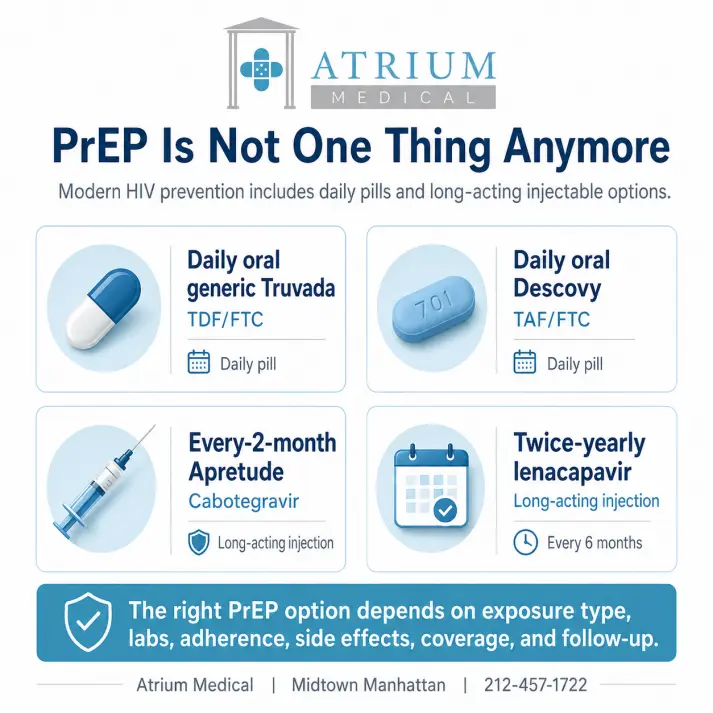
Modern PrEP includes daily oral medication and long-acting injectable options. That is good news for patients because adherence is personal: some people prefer a daily pill, some want a private routine, some struggle with pill fatigue, and some are better served by a clinic-administered injection schedule.
The medical question is not which PrEP is best. The better question is: which PrEP option is safe, realistic, covered, monitored, and matched to the type of HIV exposure we are trying to prevent?
PrEP options compared: Truvada, Descovy, APRETUDE, and lenacapavir
| Option | How it is taken | Best fit | Key clinical considerations |
|---|---|---|---|
| Generic Truvada or TDF/FTC | Daily oral pill | Broad, established oral PrEP option. Often cost-effective and widely covered. | HIV-negative status required before start. Kidney function and hepatitis B status matter. Bone health and renal monitoring may matter for some patients. |
| Descovy or TAF/FTC | Daily oral pill | Some patients where kidney or bone profile is a major concern, depending on exposure type. | Not indicated for people at risk through receptive vaginal sex. Lipids and weight/metabolic profile may matter. |
| APRETUDE or injectable cabotegravir | In-office gluteal injection. Initiation injections 1 month apart, then every 2 months. | People who prefer injections, have pill fatigue, adherence challenges, or cannot use oral tenofovir-based PrEP. | Requires clinic scheduling, HIV testing, adherence to injection windows, and follow-up. Missed injection timing matters. |
| Yeztugo or lenacapavir | Long-acting injection every 6 months after initiation protocol. | Patients who want ultra long-acting prevention and meet clinical and access criteria. | Newer option. FDA-approved June 2025. Requires careful HIV testing protocol, access and coverage navigation, and follow-up planning. |
Side effects and monitoring by medication
| Option | Common concerns to discuss with clinician |
|---|---|
| Generic Truvada / TDF-FTC | Kidney function monitoring, bone health in selected patients, nausea or headache in the first weeks. Renal and bone parameters are reviewed at baseline and periodically. |
| Descovy / TAF-FTC | Weight and lipid considerations, metabolic profile. Not for receptive vaginal sex indication. Lipids and metabolic markers should be reviewed. |
| APRETUDE / cabotegravir | Injection-site reactions, discomfort after gluteal injection. Appointment timing is part of the medication. Missing the injection window can affect protection. |
| Yeztugo / lenacapavir | Injection-site nodules or reactions. Long pharmacologic duration means side effects or problems cannot be reversed quickly after injection. Initiation protocol and access navigation matter. |
How long does PrEP take to start working?
This is one of the most important and most misunderstood questions about PrEP. Protection timing depends on the medication, the type of exposure, and adherence. PrEP is not instant.
- Daily oral TDF-based PrEP (Truvada): for receptive anal sex, high tissue-level drug concentrations may be reached within approximately 7 days of consistent daily use. For vaginal or penile tissue, concentrations may take longer. Patients should not assume protection after one or two pills.
- Daily oral TAF-based PrEP (Descovy): similar general timing considerations, though tissue distribution differs from TDF-based formulations.
- Injectable APRETUDE: requires the correct initiation schedule — two injections 1 month apart — and ongoing every-2-month dosing. Protection depends on staying on schedule.
- Injectable lenacapavir (Yeztugo): requires the correct initiation protocol and follow-up. The twice-yearly schedule is only protective if the initiation and follow-up dosing are completed correctly.
If there is concern about a very recent high-risk exposure, PEP is the appropriate pathway, not PrEP. PrEP is for ongoing prevention, not for treating a possible past exposure.
What happens at your first Atrium PrEP visit
PrEP care starts with a clinical evaluation, not just a prescription. Here is what a first visit typically includes at Atrium:
- Private discussion of risk, exposure history, and prevention goals.
- HIV test — required before starting any PrEP medication.
- STI screening based on exposure sites: urine, throat swabs, rectal swabs, syphilis blood test as appropriate.
- Kidney function labs for oral tenofovir-based PrEP options.
- Hepatitis B and C review.
- Pregnancy testing when applicable.
- Medication choice discussion: oral vs injectable, side-effect profile, coverage, adherence, privacy preferences.
- Insurance verification, prior authorization route, PrEP-AP discussion, manufacturer co-pay support.
- Prescription or injection planning and pharmacy routing.
- Follow-up schedule: typically within 30 days after starting, then every 2 to 3 months depending on the medication.
Who should consider PrEP?
PrEP may be worth discussing if any of the following apply:
- You have a partner with HIV, especially if viral load status is unknown or not consistently suppressed.
- You have partners whose HIV status you do not know.
- You use condoms inconsistently or want additional protection beyond condoms.
- You recently had gonorrhea, chlamydia, syphilis, or another STI.
- You have multiple sexual partners or changing sexual networks.
- You are a man who has sex with men, or a transgender, nonbinary, or gender-diverse person who wants HIV prevention.
- You are trying to conceive, pregnant, or breastfeeding and have possible HIV exposure.
- You inject drugs or have partners who inject drugs.
- You simply want a private, medically supervised way to reduce HIV risk.
A PrEP visit is not a morality interview. It is a prevention visit.
The PrEP lab and monitoring lifecycle
PrEP only works safely when the monitoring is built into the plan.
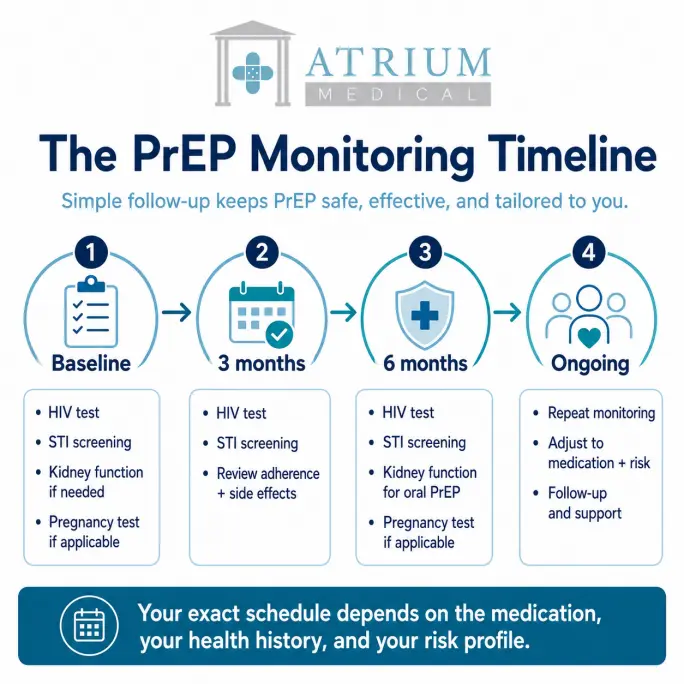
| Stage | What is usually checked | Why it matters |
|---|---|---|
| Before starting PrEP | HIV antigen/antibody test and when clinically needed HIV RNA testing; STI screening; kidney function for oral tenofovir-based PrEP; hepatitis B status; pregnancy testing when applicable; medication and risk review. | PrEP should not be started in someone with undiagnosed HIV. Baseline labs help choose between oral and injectable options and identify infections that need treatment. |
| Early follow-up | Side effects, adherence, test results, medication access, pharmacy or insurance issues, whether the chosen method fits the patient's life. | The first weeks often reveal whether the plan is realistic. |
| Every 2 to 3 months | Repeat HIV testing, STI screening based on exposure sites, symptom review, pregnancy testing when applicable, refills or injection visits, and adherence review. | Ongoing HIV testing and STI screening are central to safe PrEP care. For injectable PrEP, appointment timing is part of the medication. |
| Every 6 to 12 months | Kidney function for oral tenofovir-based PrEP, lipids and metabolic review when relevant, hepatitis review, vaccines, mental health, sexual health goals, and whether PrEP is still needed. | PrEP should stay connected to primary care: labs, vaccines, metabolic health, medications, and prevention over time. |
HIV testing before and during PrEP
HIV testing is not optional paperwork. It is the safety foundation of PrEP. Starting or continuing PrEP in someone with undiagnosed HIV can delay the right treatment and increase the risk of resistance. That is why a PrEP visit includes HIV testing before starting and ongoing testing during follow-up.
This is also why an online-only or casual refill model can be weak. The prescription is only one part of the system. The testing and follow-up are what make the prevention plan medically sound.
Acute HIV symptoms: when to get urgent evaluation before starting PrEP
Starting PrEP during undiagnosed acute HIV infection is one of the primary safety risks associated with PrEP. This is not a theoretical concern — it is why HIV testing before starting is non-negotiable.
If you have had a recent high-risk exposure and are now experiencing any of the following symptoms, get urgent clinical evaluation and HIV testing before starting any medication:
- Fever or night sweats
- Skin rash
- Sore throat
- Swollen lymph nodes
- Muscle aches or severe fatigue
- Mouth sores
These symptoms can represent acute HIV seroconversion illness. Starting PrEP at this stage is not appropriate and requires clinical guidance. If symptoms are severe or you cannot reach a clinician quickly, go to an emergency room.
STI screening, doxy-PEP, and vaccines
PrEP prevents HIV. It does not prevent chlamydia, gonorrhea, syphilis, herpes, HPV, hepatitis, or other infections. STI screening belongs inside PrEP care, not as an afterthought.
Depending on exposure, testing may include urine testing, throat swabs, rectal swabs, syphilis blood testing, hepatitis testing, pregnancy testing when applicable, and symptom-specific evaluation. Atrium keeps the conversation straightforward and private.
Doxy-PEP for STI prevention
Many patients now ask about doxy-PEP after hearing about it alongside PrEP. Doxy-PEP is a separate strategy — doxycycline taken after condomless sex — that may reduce certain bacterial STI risks for some patients.
It is not for everyone and it is not a substitute for STI screening. Not all patients are candidates, and the evidence base continues to develop. If you are interested in doxy-PEP, this is a clinical conversation, not a self-prescription decision.
Vaccines often reviewed during PrEP care
PrEP visits are a natural place to close vaccine gaps. Vaccines commonly reviewed include:
- Hepatitis A
- Hepatitis B (also relevant for some PrEP medication safety baseline)
- HPV
- Mpox where appropriate based on risk and current guidance
- Meningococcal in selected risk groups
- Routine adult vaccines as part of ongoing primary care
2-1-1 on-demand PrEP
Some patients have heard about event-driven or on-demand dosing — sometimes called 2-1-1 PrEP — for planned sexual activity. This is a real clinical concept discussed in some settings, but it comes with important caveats.
- 2-1-1 dosing is not the same as daily PrEP and is not appropriate for everyone.
- Evidence for on-demand dosing in clinical guidelines is specific to TDF-based oral PrEP for anal sex exposure. It does not apply to Descovy, injectable PrEP, or vaginal or injection drug exposure.
- It should only be used after a clinician discussion about whether the approach fits the patient’s specific exposure pattern and circumstances.
- It does not apply to APRETUDE or lenacapavir.
If you have heard about on-demand PrEP and want to know whether it applies to your situation, raise it at your evaluation visit.
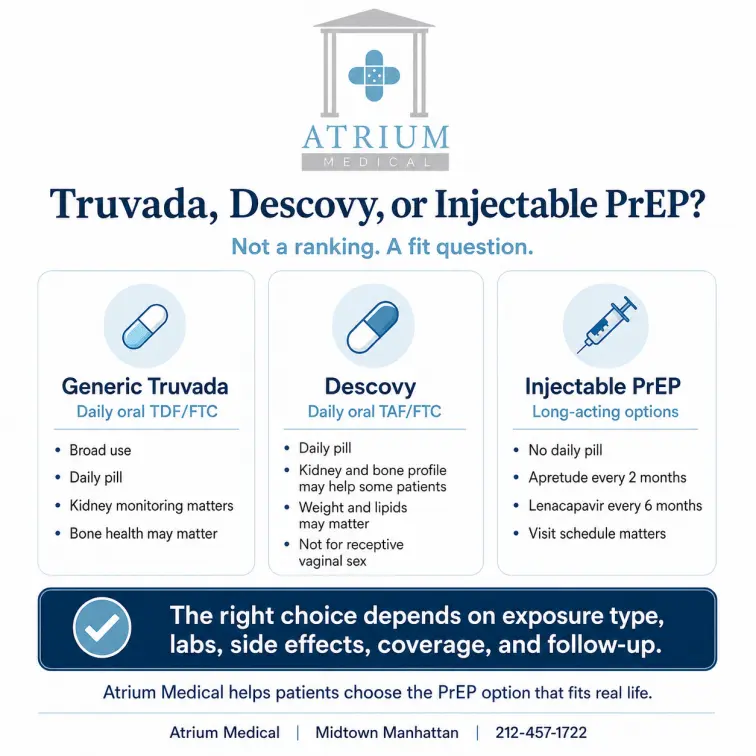
Truvada vs Descovy: not just a brand choice
Generic Truvada, also called TDF/FTC, is a long-established daily oral PrEP option with broad use and usually favorable cost and coverage. It requires kidney function review, and for some patients bone health and renal monitoring matter.
Descovy, also called TAF/FTC, may be attractive for some patients where kidney or bone considerations matter. But it is not a universal upgrade. Descovy is not indicated for people at risk of HIV through receptive vaginal sex because effectiveness has not been evaluated in that population. Descovy may also raise weight and lipid questions in some patients. See the Descovy HCP information for full prescribing details.
The right choice is about indication, exposure type, safety, coverage, adherence, and follow-up — not brand prestige.
Long-acting injectable PrEP: APRETUDE and lenacapavir
Long-acting injectable PrEP is the biggest change in the PrEP conversation. For some patients, the barrier is not willingness. It is daily-pill fatigue, privacy, travel, schedule chaos, or simply not wanting to remember medication every day.
APRETUDE, the brand name for injectable cabotegravir, is given by a healthcare professional as a gluteal intramuscular injection. The initiation schedule uses two injections 1 month apart, followed by injections every 2 months. Falling outside the injection window can reduce protection and create resistance concerns. Sources: APRETUDE getting started resources and APRETUDE HCP dosing information.
Lenacapavir, marketed as Yeztugo, is the newest twice-yearly injectable PrEP option. It was FDA-approved in June 2025 based on PURPOSE 1 and PURPOSE 2 evidence. Its arrival gives patients a third injectable pathway alongside daily oral options and APRETUDE.
PrEP for women, pregnancy, and conception planning
PrEP is not just for one patient population. Women can and should use PrEP when HIV exposure risk exists. Medication choice matters: Descovy is not indicated for receptive vaginal sex, while generic Truvada and injectable options may be appropriate depending on the clinical picture.
PrEP may be appropriate during conception, pregnancy, or breastfeeding when HIV exposure risk exists. The clinical discussion should include medication safety in pregnancy, coordination with OB-GYN care when appropriate, and the distinction between options that have more safety data in pregnancy versus those with more limited data.
PrEP does not need to be stopped when someone is trying to conceive or is pregnant if there is ongoing risk. The decision should be individualized.
Stopping or pausing PrEP
PrEP is not necessarily a lifetime commitment, but stopping requires clinical planning — especially for injectable options.
- For daily oral PrEP: stopping depends on when the last possible exposure was and the time needed to maintain protective drug levels after stopping. Discuss timing with the clinician before stopping.
- For APRETUDE (cabotegravir injection): injectable PrEP has a long pharmacologic tail. Cabotegravir stays in the body for months after the last injection. This creates a period of subtherapeutic drug levels that can increase resistance risk if HIV is acquired after stopping. Stopping APRETUDE requires a transition plan — typically oral bridging or discussion of the specific timeline.
- For lenacapavir (Yeztugo): similarly, stopping a twice-yearly injectable requires planning because the drug remains in the body for an extended period.
- Do not stop after a recent exposure without clinical guidance.
If exposure risk has genuinely ended, stopping PrEP is a reasonable clinical discussion. If it is a pause, a return plan matters.
Continuing PrEP started elsewhere
Patients who have moved to New York, switched practices, or been on PrEP through another provider can continue care at Atrium. When you call or come in, bring the following:
- Medication name and current dose
- Date and result of last HIV test
- Recent labs (kidney function, STI screening) if available
- Current pharmacy information
- For injectable PrEP: date and documentation of last injection
If labs are outdated or HIV testing is not current, Atrium may need to repeat testing before continuing refills or injections. The safety requirements do not change based on where PrEP was started.
Privacy, insurance, and explanation-of-benefits concerns
Privacy is a real concern for many PrEP patients. If your insurance is under a parent’s, spouse’s, or partner’s plan, your insurer may send an explanation of benefits (EOB) to the primary policyholder. Pharmacy records may also be visible depending on the plan and portal.
Atrium can discuss practical options before labs, medications, or visits are routed through insurance. However, Atrium cannot guarantee how an insurer communicates, how a pharmacy sends receipts, or what appears in a shared portal.
Options that may help:
- Using PrEP-AP, which covers costs outside of insurance for eligible patients, may avoid insurance billing entirely in some situations.
- Manufacturer co-pay programs and patient assistance may reduce what goes through a shared plan.
- Generic oral PrEP may have lower cost and more pharmacy flexibility.
- Raising confidentiality concerns before the visit allows us to discuss the options before anything is routed.
Sexual history, STI results, and the fact of a PrEP visit are kept private within Atrium’s medical record. New York has strong confidentiality protections for sexual health information.
Cost, insurance, PrEP-AP, and co-pay help in New York
Cost is one of the biggest reasons patients delay or stop PrEP. In New York, the financial pathway can be better than many patients expect, but it has to be navigated correctly.
| Cost pathway | What it can help with | Atrium role |
|---|---|---|
| Commercial insurance | Medication, labs, visits, prior authorization, pharmacy benefit or medical benefit depending on the product. | Verify insurance, document medical need, complete labs, coordinate prior authorization when needed. |
| New York State PrEP-AP | Health care and laboratory costs that are part of PrEP for eligible patients. May avoid insurance billing for some patients. | Help patients understand eligibility and how PrEP-AP may fit with their insurance or lack of coverage. |
| Manufacturer co-pay programs | Out-of-pocket medication costs for eligible commercially insured patients for specific branded PrEP medications. | Point eligible patients toward enrollment and coordinate pharmacy routing when appropriate. |
| Generic oral PrEP | Often lower medication cost and broad availability. | Evaluate whether generic TDF/FTC is clinically appropriate and monitor kidney function and safety. |
Why PrEP belongs in primary care
PrEP is HIV prevention, but the visit often reveals much more. Patients may need STI screening, vaccines, hepatitis testing, kidney function review, blood pressure follow-up, cholesterol discussion, mental health support, travel counseling, pregnancy planning, contraception counseling, or an annual physical. That is why PrEP fits naturally inside primary care.
A public sexual-health clinic can be an excellent resource. Atrium serves patients who want PrEP integrated into a private, ongoing internal medicine relationship: one office, one chart, one clinician who can connect prevention to the rest of health.
For Midtown patients, access matters too. Atrium is near the 59th Street subway hub, Grand Central, Park Avenue, Lexington Avenue, Sutton Place, Turtle Bay, and the broader Midtown office corridor. PrEP works best when follow-up is easy enough to actually happen.
PrEP FAQ
Is PrEP only for gay men?
No. PrEP is for HIV-negative people who may be exposed to HIV through sex or injection drug use. That can include men who have sex with men, women, transgender and nonbinary patients, people with partners whose HIV status is unknown, people with partners who have HIV, people with recent STIs, and anyone who wants additional HIV prevention.
Do I need to take PrEP every day?
Daily oral PrEP is taken every day. Injectable options follow a clinic-administered schedule — every 2 months for APRETUDE after initiation, or every 6 months for lenacapavir after initiation. The right schedule depends on the medication and patient.
What is PEP and how is it different from PrEP?
PEP is post-exposure prophylaxis, emergency medication started after a possible HIV exposure. It must be started within 72 hours of exposure and taken for 28 days. PrEP is taken before and ongoing to prevent future exposures. If you may have been exposed to HIV in the past 72 hours, call immediately or go to an emergency room. Do not start PrEP and expect it to treat a recent exposure.
How long does PrEP take to start working?
Protection timing depends on the medication and exposure type. Daily oral TDF-based PrEP may reach high tissue-level drug concentrations for anal sex exposure within approximately 7 days of consistent use. For other exposure types, the timeline may differ. Injectable PrEP requires the correct initiation schedule. PrEP is not instant — patients should not assume protection after one or two pills or a single injection.
What is APRETUDE?
APRETUDE is injectable cabotegravir for PrEP. It is administered by a healthcare professional as a gluteal intramuscular injection. The usual initiation schedule uses two injections 1 month apart, then injections every 2 months.
What is lenacapavir or Yeztugo?
Lenacapavir, marketed as Yeztugo for PrEP in the United States, is a long-acting injectable PrEP option administered every 6 months after initiation. It was FDA-approved in June 2025. It gives patients another option when daily oral medication or every-2-month injections are not the best fit.
What is the difference between Truvada and Descovy?
Generic Truvada, or TDF/FTC, and Descovy, or TAF/FTC, are both oral PrEP options but they are not interchangeable for every patient. Truvada has broad use and often lower cost. Descovy may be considered for some patients where kidney or bone profile matters, but it is not indicated for people at risk through receptive vaginal sex.
What about 2-1-1 on-demand PrEP?
Some patients ask about event-driven or on-demand dosing, sometimes called 2-1-1 PrEP. This is a real clinical concept for some patients using TDF-based oral PrEP for anal sex exposure, but it is not appropriate for everyone and does not apply to Descovy, injectable PrEP, vaginal sex exposure, or injection drug use. Discuss whether it fits your situation at your evaluation.
What about doxy-PEP?
Doxy-PEP is a separate prevention strategy — doxycycline taken after condomless sex to reduce certain bacterial STI risks for some patients. It is not for everyone, not a substitute for STI screening, and should be clinician-guided. PrEP prevents HIV; doxy-PEP is aimed at bacterial STIs for appropriate candidates.
Does PrEP protect against other STIs?
No. PrEP reduces HIV risk. It does not prevent chlamydia, gonorrhea, syphilis, herpes, HPV, hepatitis, or other infections. STI screening is part of good PrEP care.
What labs do I need before starting PrEP?
A typical start includes HIV testing, kidney function review for oral tenofovir-based PrEP, hepatitis B status, STI screening, pregnancy testing when applicable, and medication review. The exact plan depends on the patient and medication.
Can I start PrEP the same day?
Sometimes. Same-day start may be possible when appropriate testing, clinical history, and medication access are aligned. If there is concern for recent HIV exposure, symptoms of acute HIV, abnormal labs, or missing information, the plan may need additional testing first.
What if I miss PrEP doses or miss an injection appointment?
Call the practice. Missed daily pills and missed injection windows are handled differently. Injectable PrEP timing is especially important because protection and resistance risk depend on staying on schedule.
Does insurance cover PrEP?
Coverage depends on the plan, medication, pharmacy pathway, labs, and eligibility. In New York, many patients can access PrEP with low or no out-of-pocket cost through insurance, PrEP-AP, or manufacturer support, but the pathway should be verified before assuming.
Can Atrium help with PrEP-AP or co-pay support?
Atrium can help patients understand whether PrEP-AP, manufacturer co-pay support, insurance coverage, prior authorization, or pharmacy coordination may apply. The goal is to reduce friction so patients can stay on prevention.
Can women take PrEP?
Yes. Women can use PrEP when they may be exposed to HIV. Medication choice matters: Descovy is not indicated for receptive vaginal sex, while other options may be appropriate depending on the patient and clinical context.
Can trans patients take PrEP?
Yes. PrEP can be used by transgender and nonbinary patients. Medication choice and follow-up should account for anatomy, exposure type, hormone therapy, labs, privacy, and patient goals.
Can I use PrEP while trying to get pregnant, pregnant, or breastfeeding?
PrEP may be appropriate for some patients during conception, pregnancy, or breastfeeding when HIV exposure risk exists. This requires individualized discussion with the clinician and, when appropriate, coordination with OB-GYN care.
Can I stop PrEP?
Yes, but discuss the timing with your clinician. For oral PrEP, timing depends on last exposure and drug levels. For injectable PrEP — especially cabotegravir and lenacapavir — the drug stays in the body for months and stopping requires a transition plan to avoid subtherapeutic levels that could increase resistance risk if HIV were acquired during that window.
I am already on PrEP from another provider. Can I continue at Atrium?
Yes. Bring your medication name, date and result of last HIV test, recent labs, pharmacy information, and for injectable PrEP the date of your last injection. If testing is outdated, Atrium may need to repeat it before continuing.
Will my insurance tell someone I am on PrEP?
Your insurer may send an explanation of benefits to the primary policyholder if you are on a shared plan. Atrium can discuss options before routing labs or medications through insurance. PrEP-AP may avoid insurance billing for eligible patients. Raise confidentiality concerns at the start of your visit.
What happens if I test positive for an STI while on PrEP?
An STI does not mean PrEP failed. It means screening worked. Atrium can treat or refer as appropriate, discuss partner notification, retesting, prevention, and whether the PrEP plan should change.
Can PrEP follow-up be done by televisit?
Some counseling, lab review, side-effect discussion, and refill planning can be handled by televisit when appropriate. Testing, swabs, injection visits, and some symptoms require in-person care.
Why choose Atrium instead of an online PrEP service?
Online services can be convenient, but PrEP care often works better when testing, STI screening, side effects, insurance, vaccines, and primary care are connected. Atrium offers PrEP care inside a real Midtown Manhattan primary care practice. Online services also cannot administer injectable PrEP, a limitation that matters for patients who prefer APRETUDE or lenacapavir.
Is Atrium listed as a PrEP provider?
Yes. Atrium Medical appears in the official APRETUDE PrEP provider locator and the New York State Department of Health AIDS Institute PrEP/PEP Voluntary Provider Directory. Patients can verify Atrium externally and then call the practice to schedule care.
Medical sources and official references
This page was written and reviewed by Atrium Medical Primary Care using current official guidance, clinical literature, and government sources where applicable. Sources may be updated as guidelines change
- CDC: PrEP for HIV prevention
- CDC: PrEP clinical guidance for HCP
- HIV.gov: pre-exposure prophylaxis overview
- CDC MMWR: lenacapavir PrEP FDA approval and clinical recommendations
- APRETUDE HCP dosing and drug interactions
- NYS DOH AIDS Institute PrEP/PEP Voluntary Provider Directory
- NYC Health: PrEP information
- NYS Health: PrEP-AP consumer information
Book PrEP Care in Midtown Manhattan
PrEP works best when it starts before exposure and stays connected to real medical care. Atrium’s clinicians can help you begin or continue PrEP with the right labs, the right medication, and follow-up that fits your life in New York.
Atrium Medical is located at 160 East 56th Street, 12th Floor, in Midtown East Manhattan, convenient to the 59th Street subway hub, Grand Central, Park Avenue, and Lexington Avenue. Book online, check insurance, or call 212-457-1722.
.footer-container {
display: flex;
align-items: center;
justify-content: center;
gap: 10px;
width: 100%;
}
/* Desktop ke liye: Wrap band rakho */
@media (min-width: 769px) {
.footer-container {
flex-wrap: nowrap;
}
}
/* Mobile ke liye: Wrap chalu rakho */
@media (max-width: 768px) {
.footer-container {
flex-wrap: wrap;
text-align: center;
}
}