ALLERGY TESTING IN NYC: WHAT TO EXPECT, WHAT YOU’LL LEARN, AND WHY IT MATTERS

Same-Day Allergy Testing in NYC: What to Expect, What We Test For, and Why It's Worth Knowing
Allergies are a year-round phenomenon in New York. As tree pollen peaks in April and May, many patients start experiencing persistent congestion, sneezing, itchy eyes, and sinus pressure that can linger for weeks. If you’re tired of guessing what’s triggering your symptoms, allergy testing can give you clear answers in a single visit.
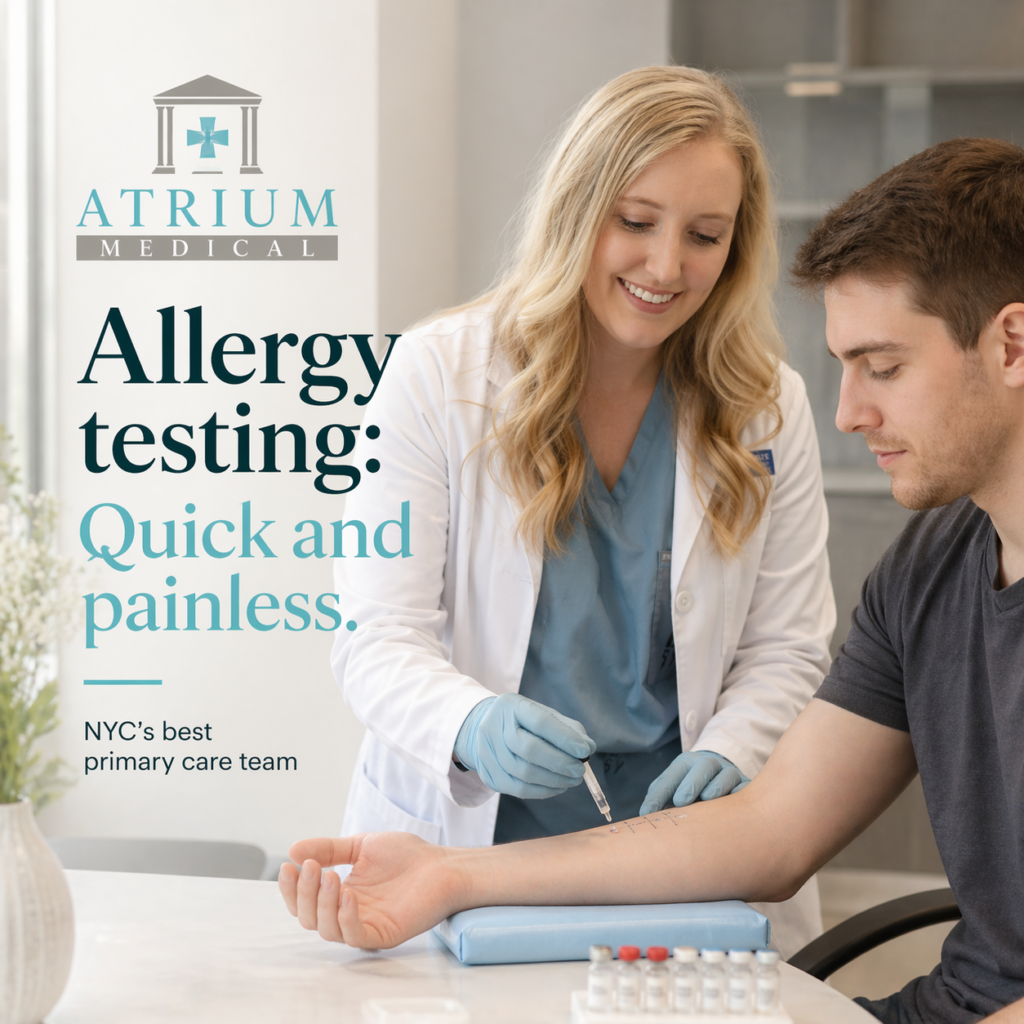
At Atrium Medical in Midtown Manhattan, we perform in-office skin prick testing, allowing you to see results in real time before you leave.
Below are the most common questions patients ask before coming in.
What is a skin prick allergy test?
A skin prick test is the most common and clinically reliable way to identify immediate-type allergic reactions.
Small amounts of common allergens are applied to the skin, usually on the forearm or back, using a tiny, superficial prick. If you are allergic to a substance, a small raised bump, similar to a mosquito bite, will appear within minutes.
What does allergy season actually look like in New York City, month by month?
This is where living in New York is different from almost anywhere else. You’re not just dealing with suburban pollen — you’re in a dense urban environment where pollution amplifies allergen irritation, building ventilation circulates indoor allergens year-round, and green spaces are concentrated rather than spread out. Central Park, Riverside Park, and the tree-lined blocks of Midtown and the Upper East Side become pollen corridors in spring.
Here’s what the calendar actually looks like:
February — March: Tree pollen season begins earlier than most people expect. Elm and maple trees start releasing pollen during warm spells, sometimes as early as late February. Patients who think they have a “winter cold” in March are often experiencing the first wave of tree pollen.
April — June: Peak tree pollen. Oak, birch, and maple are the dominant culprits. This is the highest-symptom period for most pollen-allergic New Yorkers. If you are symptomatic right now, this is why.
May — June: Grass pollen begins as tree pollen tapers. The two seasons overlap, which is why some patients feel like their symptoms never let up from April through June — they may be reacting to two separate allergen sources sequentially.
July — August: A relative lull for pollen-sensitive patients, though mold spores peak in summer heat and humidity. If your symptoms are worst in July and August, mold is a more likely driver than pollen. Air conditioning helps with pollen but recirculates indoor mold if filters aren’t maintained.
August — October: Ragweed season. This is the second major pollen peak in New York and affects a large portion of the population with environmental allergies. Ragweed is wind-pollinated and highly efficient — a single plant can produce a billion pollen grains in a season. Ragweed pollen can travel hundreds of miles, which means even patients who don’t live near obvious vegetation are exposed.
Year-round: Dust mites, cockroach allergens, and pet dander don’t follow a seasonal calendar. In New York’s older housing stock — pre-war buildings, carpeted apartments, poorly ventilated spaces — these are often the primary drivers of chronic symptoms that patients assume are sinus issues or frequent colds.
Understanding which part of this calendar matches your symptom pattern is often the first step toward getting real relief.
Why does testing matter if I already know I have allergies?
Because “I have allergies” is not an actionable diagnosis.
Knowing that you have environmental allergies tells you almost nothing about how to treat them. Knowing that you are specifically sensitized to birch pollen, dust mites, and cat dander — and not to grass or ragweed — means your physician can target your treatment, your avoidance strategies, and your medication timing precisely.
There’s also something many patients don’t expect: the test frequently reveals allergies they had no idea they had. That matters more than it might sound.
What is oral allergy syndrome — and why does it explain the itchy mouth you get from apples?
This is one of the most underdiagnosed patterns in allergy medicine, and it’s worth understanding.
Many proteins in certain raw fruits, vegetables, and tree nuts share a similar molecular structure to proteins found in tree pollen. Your immune system, already sensitized to birch or alder pollen, encounters the same structural pattern in a raw apple, peach, cherry, or almond — and reacts.
The result is oral allergy syndrome (OAS): itching or tingling in the mouth, lips, or throat within minutes of eating certain raw foods. It’s almost always tied to an underlying pollen allergy the patient may not have known they had.
The most common cross-reactive pairings:
- Birch pollen (peaks April-May in NYC) — apples, pears, peaches, cherries, plums, nectarines, apricots, almonds, hazelnuts, carrots, celery, parsley
- Ragweed pollen (peaks August-October) — cantaloupe, honeydew, watermelon, zucchini, cucumber, banana
- Grass pollen (peaks May-June) — peaches, celery, tomatoes, melons
This is why someone who has always eaten peaches without issue can suddenly develop a reaction in their 30s or 40s — their pollen allergy worsened, crossed a threshold, and the cross-reactivity became symptomatic. It’s also why cooking usually eliminates the reaction: heat denatures the protein structure that the immune system is recognizing.
If you’ve noticed that certain raw fruits or vegetables cause mouth tingling but cooked versions are fine, you likely have OAS driven by an underlying environmental allergy. Skin testing can confirm which pollen is driving it.
A note on cat allergies — and why “I got used to my cat” is often not what’s happening
New York City has a high rate of cat ownership relative to most American cities, and cat allergy is one of the most common sensitizations we see in skin testing.
The relevant protein is Fel d 1, produced primarily in cat saliva and sebaceous glands. It’s sticky, lightweight, and becomes airborne easily. In a New York apartment — smaller than most American homes, often with limited ventilation — Fel d 1 concentrations build rapidly and persist on surfaces, fabrics, and walls for months after a cat has been removed.
A few things worth knowing:
Patients often report that they “got used to” their cat over time. In some cases this is true adaptation. In others, it’s the gradual development of chronic low-grade inflammation that has become the new baseline — persistent congestion, fatigue, and mild sleep disruption that the patient no longer registers as allergy symptoms because they’ve had them for so long.
Cat allergy is also one of the success stories for allergen immunotherapy. Allergy shots or sublingual therapy can meaningfully reduce sensitivity to cat dander over time, to the point where patients who previously couldn’t be in a room with a cat can tolerate living with one.
NYC Mayor Zohran Mamdani — a lifelong New Yorker — has spoken publicly about undergoing allergy treatment for cat sensitivity. It’s a good illustration of something our patients often don’t realize: you don’t have to choose between getting rid of your pet and suffering. Immunotherapy may offer a solution. Testing helps guide the way.
What types of allergies can this test detect?
We offer comprehensive allergy testing to help identify the specific triggers causing your symptoms. Our panel includes:
Environmental allergens: pollen (trees, grasses, weeds), dust mites, mold spores, pet dander, and cockroach allergens — a significant and often overlooked trigger in older NYC building stock
Food allergens: peanuts, tree nuts, dairy, eggs, wheat, soy, shellfish, and fish — tested when symptoms or history suggest a food trigger
Insect allergens: bee, wasp, and hornet venom
Medication allergies: penicillin and select antibiotics, when clinically appropriate
Other sensitivities: latex, fragrances, and certain metals including nickel
Your provider will tailor the panel based on your specific symptoms and history. Not everyone needs the full panel.
How quickly do I get results?
Results are available during the same visit.
Most reactions develop within 15 to 20 minutes, and your provider will review the results with you in real time. This is a key advantage over blood testing, which may take several days and generally provides less sensitivity for environmental allergens.
Does the test hurt?
The test is generally well tolerated. The sensation is more of a light scratch than a needle. If a reaction occurs, the area may feel mildly itchy for a short period. Most patients are surprised by how straightforward it is.
How should I prepare?
You must stop antihistamines before testing. They suppress the allergic response and will cause false negatives — meaning the test will miss real allergies you have.
Stop the following at least 5 full days before your appointment:
- Benadryl (diphenhydramine)
- Claritin (loratadine)
- Zyrtec (cetirizine)
- Allegra (fexofenadine)
- Xyzal (levocetirizine)
Also check cold medications, sleep aids, and any combination products — many contain antihistamines that are easy to miss on the label.
If you are unsure whether a medication you take will affect the test, call us before your appointment. Do not guess.
What happens during the appointment?
Your visit typically includes:
- A brief consultation to review symptoms and history
- Placement of allergen drops on the skin
- Gentle skin pricks to introduce each allergen
- A 15 to 20-minute observation period
- Immediate interpretation of results with your provider
By the end of the visit, you will know which substances are triggering your symptoms.
Is skin testing better than a blood test?
For most environmental allergies, yes. Skin testing is more sensitive, faster, and allows your physician to interpret results in the context of your symptoms in real time. Blood tests (specific IgE panels) are useful in certain situations — patients on medications they can’t stop, patients with severe skin conditions, or young children — but they typically provide less granular detail for environmental allergens and require waiting for lab processing.
Can food allergies be diagnosed with this test?
Skin testing can help identify potential food allergies, but results must be interpreted carefully. False positives can occur with food panels, so your provider will always correlate findings with your clinical history before making any recommendations. A positive skin test to a food is not a diagnosis on its own. It’s a data point in a larger clinical picture.
What happens after the test?
Based on your results, your provider will build a personalized plan. For most patients this includes some combination of:
- Environmental modifications to reduce exposure to confirmed triggers
- Targeted medications matched to your specific allergen profile and symptom timing
- Seasonal prevention strategies — starting medications before your peak season rather than after symptoms are already established
For patients with more persistent or severe allergies, we may recommend referral to an allergist for immunotherapy. Allergy shots and sublingual therapy are the only treatments that address the underlying sensitivity rather than just managing symptoms. For cat allergy, dust mite allergy, and certain pollen allergies, the outcomes from immunotherapy are well-established and meaningful.
Do you offer same-day appointments?
Yes. We offer same-day and next-day appointments whenever possible. Our Midtown Manhattan location at 160 East 56th Street is convenient for patients coming from work, nearby neighborhoods, or via the 59th Street subway hub.
Do you accept insurance?
We accept Aetna, Cigna, Blue Cross Blue Shield, UnitedHealthcare, Oxford, and most major plans. Allergy testing is covered as a diagnostic procedure under most of these plans when ordered by a primary care physician. Our team can verify your coverage before your visit.