
24/7 Monitoring Used to Require an ICU Bed. Now It’s a Ring on Your Finger.
Published by Dr. Shilpa Paradkar Singh, MD
Board-Certified Internal Medicine | Founder, Atrium Medical Primary Care, NYC
Last Updated: September 2026
Fast answer
Continuous monitoring was traditionally reserved for patients sick enough to be in a hospital bed. Consumer wearables have inverted that model. Millions of healthy people now generate something close to continuous physiological data with no shared standards yet for what a device should flag, to whom, and when. A 2026 AMA and Medscape survey of 2,222 physicians across six countries found that 97% review wearable data in some capacity, yet no country has full clinical workflow integration above 6%. Patients already have the data. Medicine has not caught up to the sheer volume of it.
At Atrium Medical, we review Oura, Apple Watch, WHOOP, Garmin, and continuous glucose monitor data as part of a standard primary care visit at 160 East 56th Street in Midtown Manhattan to form a more complete picture of your health. Most major insurance plans are accepted.
On This Page
- About half of my patients under 45
- Medicine has always worked in snapshots
- Collecting data is not the same as monitoring it
- Medicine has fought a version of this fight before
- More monitoring is not automatically safer
- More data has not automatically produced better outcomes
- The questions this raises
- The most useful comparison is you versus you
- What each metric is actually measuring
- How this plays out by device
- Some signals do cross into serious clinical territory
- When a signal looks real, what happens next?
- The wearable I haven't mentioned yet: continuous glucose monitors
- Wearables, PMOS, and cycle tracking
- This is not a niche subject any more
- When I'd contact a doctor, and when I'd close the app
- Bring us your data
- FAQ
About half of my patients under 45
About half of my patients under 45 now seem to wear an Oura Ring.
They bring the data in. One patient wants to know why her HRV has fallen for several nights. Another slept well but is worried because Oura says otherwise. Someone else sees his resting heart rate rise after a weekend away and wonders whether something is wrong. A number of younger patients come in worried about unexplained fast heart rates or fatigue that started after a viral illness, sometimes pointing toward post-viral autonomic dysfunction or POTS. The observed pattern is often a persistent, unexplained rise in resting heart rate, 5-10 beats above their normal baseline, sustained over weeks, an overnight HRV that drops and doesn’t recover with rest, and a heart rate that jumps more than 30 beats per minute on standing.
These are now routine primary care questions. They were not ten years ago. Most of the time, the answer is reassuring. The device has noticed something real, but the patient has assigned more meaning to it than the data can support.
Medicine has always worked in snapshots
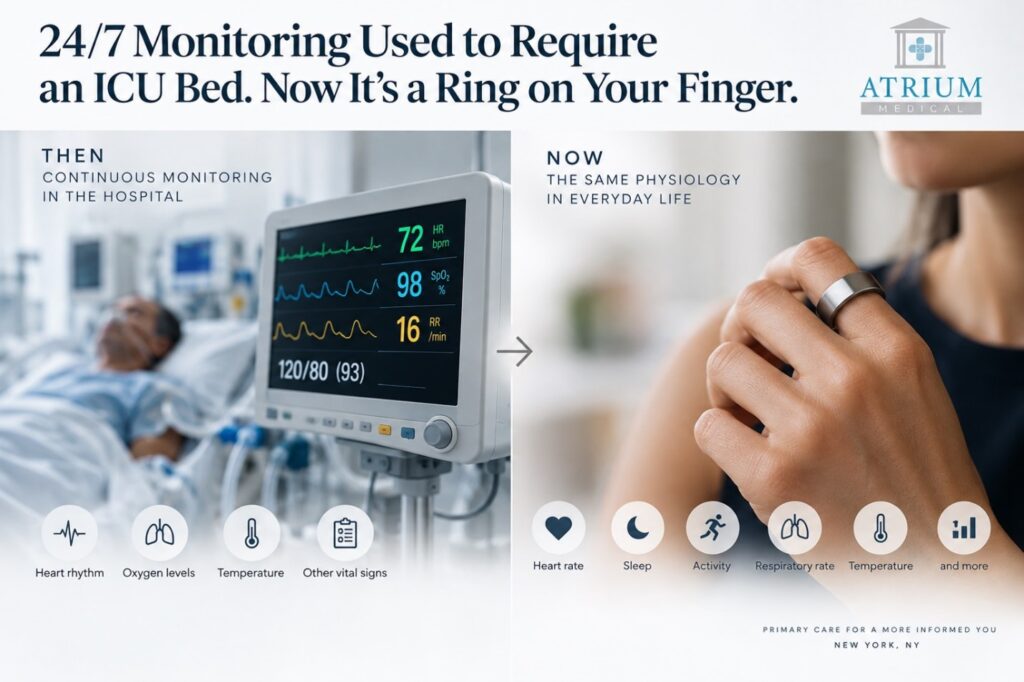
A routine physical gives me a blood pressure and pulse at one moment, say 10:15 on a Tuesday. A 12-lead ECG gives me ten seconds of your heart’s electrical activity. A Holter monitor gives me a day or two of continuous rhythm, and only because I had a specific clinical reason to order it. Hospital telemetry monitors continuously, but only for patients sick enough to be in a bed, because someone needs to know the instant something changes. Every one of those tools exists because continuous monitoring has historically been expensive, intrusive, or both, so medicine reserved it for people who were already sick or already under suspicion. Oura, Apple Watch, WHOOP, and Garmin have quietly inverted that model. The monitoring now happens first, continuously, by default, for healthy people, whether or not anyone suspected a problem. That introduces both new opportunities and new challenges.
Collecting data is not the same as monitoring it
In February 2026, Bill Ackman’s 26-year-old daughter Lucy suffered a massive brain hemorrhage and was found unconscious in her Brooklyn apartment by her sister. Ackman later used data from Lucy’s Oura Ring to determine the hemorrhage had likely occurred around 9 AM, approximately 15 hours before she was found. He wrote publicly that he wished the ring had been able to alert a family member when it detected something was wrong. Oura’s CEO, Tom Hale, replied that the company was studying whether that kind of detection might be possible in the future.
I find that both remarkable and unsettling as a physician. The ring was apparently collecting physiological information the entire time. Collecting information and providing medical surveillance are two very different things.
That story isn’t just a cautionary tale about one device. It’s the sharpest possible illustration of the question the inverted model creates: if a device is collecting physiological data while something catastrophic is happening, what obligation does it have to recognize that, and who should be told? Nobody had decided the answer in advance, because until very recently, nobody needed to.
Some of that gap is a specific, checkable, product design decision rather than a vague limitation. Oura’s readiness score is computed once each morning from data gathered overnight. It was built to show a trend, not to interrupt anyone the moment something goes wrong. Apple Watch, separately, has features purpose-built for exactly that: Fall Detection, Crash Detection, and an SOS function that can call emergency services and notify a contact if you don’t respond, features most owners have never checked are actually turned on.
Medicine has fought a version of this fight before
Radiology ran into this decades ago. A scan ordered to look at one thing sometimes turns up something else entirely, an incidentaloma, a nodule on an organ nobody was investigating. The field eventually built real, published consensus, the American College of Radiology has formal white papers on which incidental findings warrant disclosure and follow-up and which don’t, precisely because looking harder and more broadly inevitably finds things, and someone has to decide in advance what’s worth acting on.
Genomics has the same problem under a different name. Sequence someone’s whole genome for one purpose and you’ll incidentally find variants relevant to entirely different diseases. The American College of Medical Genetics and Genomics maintains an actual list of genes laboratories are obligated to report back, even when nobody asked, because the alternative, discovering something serious and staying silent, was worse.
Wearables are producing incidental findings at a scale neither field has ever had to handle, and there is no equivalent shared standard yet. Each company is quietly writing its own private version of that policy: Apple’s threshold for an irregular rhythm notification, Oura’s threshold for a temperature deviation flag. Reasonable people built those thresholds, but they were built in isolation, without the years of field-wide consensus radiology and genomics needed to get theirs right.
More monitoring is not automatically safer
Hospital telemetry has a well-documented failure mode: alarm fatigue. Staff exposed to a constant stream of mostly false alarms become desensitized and start missing the true ones, which is exactly why hospitals have entire patient-safety protocols built around alarm management. The ICU model isn’t just continuous data. It’s continuous data plus a trained person triaging it in real time, and that’s the layer missing when a consumer wearable hands someone the same kind of stream with no triage in between.
A published cardiology case report makes this concrete. A 70-year-old woman with paroxysmal atrial fibrillation developed diagnosed health anxiety around smartwatch monitoring. Over one year she performed 916 smartwatch ECGs: 701 showed sinus rhythm, 55 possible AF, 30 a high or low heart rate, and 130 were inconclusive. Ambiguous or innocuous notifications repeatedly triggered more checking and reassurance seeking, not less.
Sleep has its own version of the problem. Sleep researchers coined the term orthosomnia for a preoccupation with tracker-defined sleep that becomes bad enough to interfere with the sleep it’s meant to improve. I see milder versions of this constantly: a patient wakes feeling rested, checks an app, sees a poor score, and decides the night was a failure anyway.
And I see the physiological version too. In patients with atrial fibrillation or COPD specifically, an irregular rhythm notification can raise anxiety, and anxiety does elevate heart rate. A good wearable should increase useful awareness, not turn ordinary variance in human physiology into a continuous microscope.
None of this is free, either. An unvalidated alert that gets escalated reflexively can turn into an emergency room visit, a Holter monitor, a stress echocardiogram, sometimes a CT coronary angiogram, real cost, real radiation, real anxiety, for a signal that often needed nothing more than a single office visit and a good history. Part of my job is being the gatekeeper who understands differential diagnosis well enough to act on a genuine red flag without triggering that cascade for a normal one.
More data has not automatically produced better outcomes
Wearables are very good at producing measurements. The evidence that measurement by itself improves health is considerably less impressive.
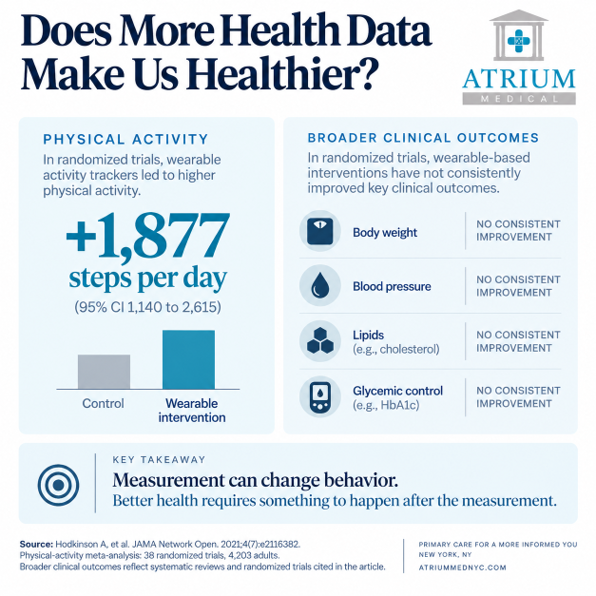
A 2021 JAMA Network Open systematic review identified 38 randomized trials involving 4,203 adults with cardiometabolic conditions. Across the trials included in the meta-analysis, wearable physical-activity interventions increased activity over a median follow-up of about 15 weeks, with an overall standardized mean difference of 0.72 (95% CI, 0.46 to 0.97), and pedometer-based interventions added roughly 1,877 steps a day compared with usual care. Programs that included additional components, often consultation or support, generally performed better than simply handing someone a tracker.
That’s somewhat useful, but it’s not the same as showing that a continuous stream of health data automatically improves clinical outcomes. Earlier systematic reviews found little consistent benefit from wearables or health apps on weight, cholesterol, blood pressure, or glycemic control on their own, and more recent meta-analyses in people with overweight or obesity have found modest improvements in some measures but no significant overall effect on weight, blood pressure, or lipids.
I don’t read that as an argument against wearables. I read it as a reminder that measurement is only the first step. A change has to be interpreted correctly, lead to a useful decision, and lead to an effective action before it improves anything. “My resting heart rate increased” is information. Whether it matters, whether it needs confirmation, and whether anything should change are all distinct questions.
The questions this raises
Once you see wearables as an inversion of how medicine has always measured physiology, the interesting questions stop being about any one metric and start being about the framework:
 What constitutes your normal, and how is it different from the population average printed on the app’s dashboard?How much deviation from that baseline actually matters?Does one signal matter on its own, or is concordance across heart rate, HRV, temperature, and respiratory rate more meaningful than any single one moving?When does an algorithmic observation become a medical finding?When should a device tell you something? Your doctor? Your family? And just as importantly, when should it leave you alone?
Nobody has fully answered these yet, including the companies building the devices.
The most useful comparison is you versus you
When a patient shows me wearable data, I start by looking at what’s normal for them. It matters less that your friend’s HRV is 80 and yours is 45. I care whether yours has usually been around 50 and has been around 30 for three weeks, what happened during those three weeks, whether anything else changed, and how you feel.
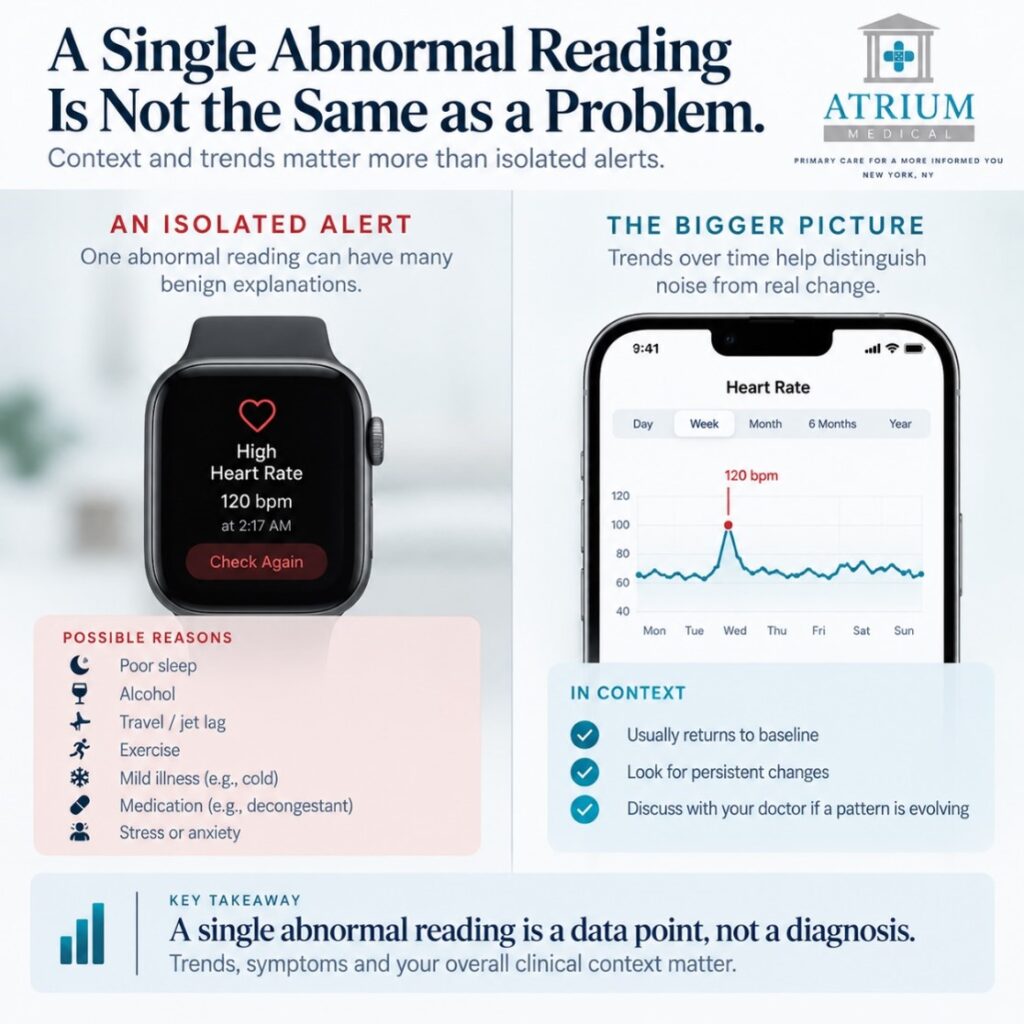
A single low HRV night after alcohol, a late flight, or a hard workout isn’t surprising physiology. A persistent shift that accompanies a higher resting heart rate, a higher respiratory rate, temperature deviation, and new fatigue is different. Several signals changing together can be more informative than any one metric, because the body is giving us a pattern rather than an isolated number.
Another version of this that seems to come up often: patients who wear an Oura Ring and an Apple Watch to bed and wake up to two disagreeing scores, Apple says sleep efficiency was great, Oura flags low recovery. Wearing two devices doesn’t give you a second opinion. It gives you two proprietary algorithms weighting the same raw signals differently, with no built-in tiebreaker. When that happens, I ignore both scores and go back to the same triage: what’s your baseline? And how do you actually feel?
What each metric is actually measuring
| Metric | What the device measures | What it estimates | What we actually care about | When to call your doctor |
|---|---|---|---|---|
| Resting heart rate | Photoplethysmography (PPG), light absorption reading microvascular blood volume, or ECG | This is a real measurement, though PPG can be thrown off by cold hands (vasoconstriction), motion, or skin tone. | A sustained shift up or down from your own baseline over weeks. | A large, unexplained, sustained rise, especially with fatigue or shortness of breath |
| Heart rate rhythm / AFib notifications | A single-lead (Lead I) ECG on capable devices, one electrical trace from finger to wrist | The algorithm's classification of regular vs. irregular. It can flag AFib but cannot detect a heart attack, a bundle branch block, or structural heart disease the way a 12-lead ECG can | A repeated notification | Any repeated irregular rhythm notification, or one plus palpitations, dizziness, or chest discomfort |
| Heart rate variability (HRV) | Beat-to-beat interval variation | Nothing directly, but normal range depends heavily on age, fitness, and the device's own algorithm | Your own multi-week trend, not a single night, and not a comparison to someone else's number | Relevant mainly alongside other changed signals |
| Sleep stages (light / deep / REM) | Movement (actigraphy) and heart rate, sometimes blood oxygen | Sleep stage itself, inferred from those signals, not measured the way a sleep study reads brainwaves directly via EEG | Total sleep duration and consistency | Chronic short sleep, or a partner reporting pauses in breathing |
| Estimated VO2 max / cardio fitness | Heart rate relative to pace or power output during exercise, plus GPS | A submaximal estimate of aerobic capacity, not measured gas exchange | The multi-month trend, which still correlates with lower all-cause mortality even as an estimate | A sustained decline paired with new exercise intolerance, not a single low session |
| Temperature deviation | Skin temperature relative to your own baseline | Nothing directly; the deviation itself is the real signal | A rise that coincides with other changes before you feel sick | A persistent fever, or any deviation with symptoms that don't resolve |
| Readiness / Recovery / Strain / Health Age | Nothing on its own | Everything, a proprietary blend of several signals above into one number | The direction it's moved over weeks, not the number itself | Generally not a diagnosis; limited clinical value. |
How this plays out by device
Oura Ring
Best at overnight trends: resting heart rate, HRV, temperature deviation, sleep duration and consistency. One practical limit: heavy grip work, deadlifts, pull-ups, barbell training, causes local vasoconstriction and can shift the ring against the finger, so heart rate data from a hard strength session is often the least reliable reading the ring produces. A chest strap or the watch is more trustworthy there. Its sleep apnea risk flag is explicitly a screening signal, not an FDA-cleared diagnostic feature, some insurers now route a positive flag straight to a STOP-Bang screen.
Apple Watch
The strongest clinical footprint around heart rate and rhythm, backed by the Apple Heart Study above. Series 12 pushes further into continuous physiology, measuring heart rate every five seconds throughout the day and HRV as often as every five minutes, a 24-fold increase over prior models. Its emergency features, Fall Detection, Crash Detection, and SOS, are separate from ordinary health-trend monitoring and worth confirming are turned on. It also holds FDA clearance for a Sleep Apnea Notification feature, one of the few wearable outputs that has actually cleared the regulatory bar for a medical finding rather than a wellness estimate.
WHOOP
Built around strain and recovery, both proprietary composite scores with no clinical equivalent. Useful the way a training log is useful, to see your own pattern over time. Not useful as a number to compare against anyone else’s, or to make a same-day medical decision from.
Garmin and other wearables
Same framework applies regardless of the logo. What matters clinically is whether a number is a direct measurement or a derived estimate, not which company made the device.
Some signals do cross into serious clinical territory
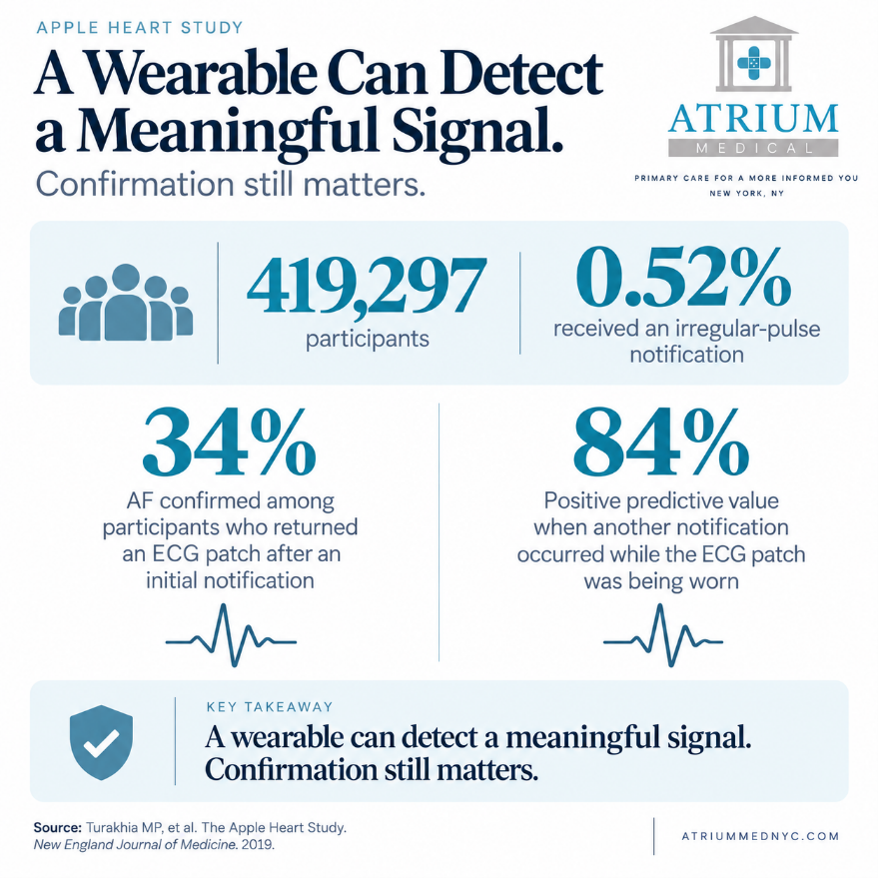
The Apple Heart Study is a good example. It enrolled 419,297 people. Only 0.52% received an irregular-pulse notification. Among participants who returned an ECG patch after an initial notification, atrial fibrillation was confirmed in 34% of them. Among subsequent notifications that occurred while a participant was actually wearing the ECG patch, 84% corresponded to atrial fibrillation on the simultaneous ECG. Those are different denominators answering different questions, and worth keeping separate: the second number is not the accuracy of the notification for everyone who receives one, it’s the concordance when a patch happened to be running at the same time.
Either way, the finding is real. A consumer device can surface a signal with enough clinical validity to deserve attention, while still requiring confirmation and context.
Sleep technology has improved too. A 2024 validation study compared Oura Gen3 with multi-night ambulatory polysomnography across 96 adults and more than 420,000 sleep-scoring epochs. Oura showed good agreement for several global sleep measures, while stage-level performance varied more. I care more about total sleep, timing, consistency, and longer trends than about treating every estimated minute of REM or deep sleep as laboratory truth.
That gap between a marketed accuracy figure and independent validation is now a live legal question, not just an academic one. An August 2026 class action challenges Oura’s advertised claim of 95% sleep-staging accuracy compared with a clinical sleep lab. The complaint argues that the ring infers sleep stages from indirect physiological signals rather than measuring brain activity directly. Oura disputes the allegations. Whatever the case’s outcome, a company’s advertised accuracy figure is not the same thing as independent clinical validation.
When a signal looks real, what happens next?
A wearable can tell us that something has changed. It usually cannot tell us why. Once a pattern is persistent, concordant with symptoms, or concerning enough to investigate, conventional medicine takes over: the pattern determines the differential diagnosis, and the differential determines what we test.
| What brings you in | What we are trying to ascertain | What may come next |
|---|---|---|
| Persistent rise in resting heart rate, often with lower HRV or fatigue | Infection or recovery from illness, anemia or iron deficiency, thyroid disease, medication effects, dehydration, autonomic dysfunction | Exam and orthostatic vitals; ECG; CBC, ferritin, TSH/free T4; additional testing based on symptoms |
| Repeated irregular-rhythm or AF notification | True atrial fibrillation or another arrhythmia versus artifact | 12-lead ECG; ambulatory rhythm monitoring such as a Holter or patch monitor |
| Higher overnight heart rate, disrupted sleep, or repeated breathing disturbance | Sleep-disordered breathing versus other causes of poor sleep and overnight physiological stress | Sleep-apnea screening; home sleep apnea testing or formal sleep evaluation when appropriate |
| Sustained decline in estimated VO2 max with a real decline in exercise tolerance | Deconditioning versus anemia, pulmonary disease, cardiovascular disease, or another systemic cause | Exam, ECG and targeted labs first; depending on the findings, echocardiography, stress testing, pulmonary evaluation, or CPET |
| Persistent postural heart-rate changes, dizziness, or post-viral exercise intolerance | Orthostatic intolerance, POTS or another autonomic disorder versus cardiac, endocrine, hematologic, medication, or volume-related causes | Orthostatic vitals or structured stand testing; ECG and targeted labs; ambulatory monitoring or specialist testing when indicated |
The wearable I haven't mentioned yet: continuous glucose monitors
Millions of people without diabetes now wear a continuous glucose monitor, Dexcom G7, Abbott Lingo, Nutrisense, purely to watch their own glucose curve. This deserves its own section because the physiology is different from anything else we’ve covered so far, and because the anxiety it produces is a slightly different shape.
A glucose rise after a meal, even up toward say 130 mg/dL, that returns to baseline within about two hours, can be entirely normal human physiology. That’s carbohydrate metabolism working as designed, not a metabolic crisis. Watching it happen in real time, on a graph, for the first time in your life, can make an ordinary process look alarming simply because you’ve never been able to see it before. For someone without diabetes, that’s rarely a useful way to use this device. When I’m evaluating metabolic health in a patient who doesn’t have diabetes, I’m looking at fasting insulin, ApoB, and HbA1c, not a real-time glucose graph, the same panel covered in more depth on the practice’s Advanced Biomarker Test Interpretation page.
None of this applies the same way if you actually have diabetes or prediabetes. For that population, a CGM is a genuinely important clinical tool, and the numbers mean something different. This isn’t a blanket dismissal of the device. It’s about who it’s for, and what a given reading means for that person.
Wearables, PMOS, and cycle tracking
A meaningful share of the women in our practice who wear an Oura Ring, or use an app like Natural Cycles, are tracking a specific thing: ovulation and fertility, often in the context of PMOS, polyendocrine metabolic ovarian syndrome.
The ring measures peripheral skin temperature at your finger. That’s a proxy for core body temperature, not a direct measurement of it. In PMOS specifically, irregular LH surges and unpredictable progesterone patterns can make that peripheral signal noisier and harder for an algorithm to read cleanly than it would be for someone with a very regular cycle.
What I think this is genuinely good for: showing you a relative trend, whether your temperature pattern looks biphasic at all, across several months. What it can’t do: replace a serum progesterone level, a TSH, or a transvaginal ultrasound when we’re actually trying to time ovulation or evaluate a fertility concern. Bring the trend in. It’s a good starting point for that conversation, not a substitute for the testing that gives us more concrete color.
This is not a niche subject any more
One ring manufacturer alone has accumulated nearly 42 billion hours of continuous biometric data from more than 5 million paying members. Whatever you think of any single company, that scale of longitudinal physiological data sitting outside the traditional health system simply didn’t exist a decade ago.
The NIH’s All of Us Research Program now holds Fitbit data from more than 59,000 participants spanning 14 years, with over 39 million step observations and 31 million sleep observations, and nearly half of those participants have that data linked to their electronic health records, genomics, and survey responses. The underlying data is becoming scientifically important faster than most physicians have a workflow to use it.
The AMA survey referenced above found the same gap from the physician side: 97% of physicians already review wearable data in some capacity, and almost none of them have it built into how they actually practice. The inversion happened faster than medicine’s frameworks for handling it did.
When I'd contact a doctor, and when I'd close the app
| Situation | My general response |
|---|---|
| Chest pain, fainting, severe shortness of breath, new focal neurologic symptoms, or another possible emergency | Seek urgent or emergency evaluation based on the symptoms. Do not wait for a wearable to confirm or dismiss them. |
| Repeated irregular-rhythm / AFib notification | Contact a clinician for confirmation, even if you feel well. |
| Persistent unexplained change in resting physiology | Review the trend and context with a clinician, particularly if several signals changed or symptoms are present. |
| Sustained decline in estimated cardio fitness plus worsening exercise tolerance | Worth clinical evaluation rather than simply training harder. |
| One low HRV night, one poor readiness score, or one odd sleep-stage estimate while you feel well | Usually zoom out, look for a trend, and close the app. |
| A score is making you repeatedly check, avoid normal activities, or seek reassurance | The monitoring itself may no longer be helping. Discuss that pattern with your clinician. |
For the first time, physicians have the possibility of seeing a patient’s physiology not as a handful of snapshots, but as a continuous story. The challenge is learning what to do with it.
Bring us your data
If your Oura, Apple Watch, WHOOP, or Garmin data has you wondering whether something’s wrong, or if you just want a second, human read on what your numbers mean for you specifically, bring it to your visit. Show us the alert or metric that concerns you, then zoom out, a 30 or 90-day trend is usually more useful than last night.
Atrium Medical Primary Care is located at 160 East 56th Street, 12th Floor, Midtown East Manhattan, a short walk from the Lexington Ave/53rd St (E, M) and 59th St-Lexington Ave (4, 5, 6, N, R, W) subway stations. We’re in-network with Aetna, Blue Cross Blue Shield, Cigna, UnitedHealthcare, and Oxford. Interpreting your wearable data happens as part of a standard primary care visit, not a separate cash-pay service.
FAQ
Not from a single night. HRV is genuinely useful as a personal trend over weeks and largely meaningless as a single number, since normal range depends on age, fitness, and how each device's algorithm calculates it.
Total sleep duration tends to be reasonably reliable. Stage-by-stage breakdowns are estimated from movement and heart rate, not measured the way a sleep study measures brain activity directly. A 2024 validation study found good agreement for several global sleep measures with more variable stage-level accuracy.
Don't panic on a single notification, but don't ignore a repeated one. Contact your doctor, especially if it recurs or comes with palpitations, dizziness, chest discomfort, or shortness of breath.
For reformatting a spreadsheet or plotting a trend, that's fine. For deciding what a pattern means medically, no. General-purpose AI tools don't have your exam, your labs, or your history, and they can describe a correlation in your data confidently without it being clinically meaningful. Use them to organize what you bring in, not to diagnose it.
No, unless your specific care team has explicitly set up that connection and told you so. Sending data to an app, or even a patient portal, does not by itself mean anyone is reviewing it in real time. Some Medicare Advantage plans have built exactly that kind of connection, routing a sleep-disturbance flag to a physician with the member's consent, but that's an explicit, opt-in clinical workflow, not something that happens automatically with any wearable you buy.
Only specific, purpose-built features can, and only if you've enabled them. Apple Watch's Fall Detection, Crash Detection, and SOS are real-time features. Overnight readiness and recovery scores, on any device, are not built for that.
Yes. Constant checking, ambiguous alerts, and fixation on daily scores can increase anxiety in some people, a pattern documented in both cardiology and sleep-medicine literature. If monitoring is driving repeated reassurance seeking or changing normal behavior, the monitoring itself deserves attention.
Sustained trends, not single readings: a resting heart rate that's shifted for weeks, a repeated rhythm notification, a sleep duration that's chronically short, or several signals moving together. Bring the trend, not just today's screenshot.
Apple Health has historically used SDNN to report heart rate variability, while Oura uses RMSSD. These are different calculations, and the devices also sample data at different times and use different algorithms. Compare your trends within the same device rather than comparing individual HRV numbers across devices.
Atrium reviews wearable data as part of a standard primary care visit, not as a separate cash-pay service. We accept most major insurance plans, including Aetna, Blue Cross Blue Shield, Cigna, UnitedHealthcare, and Oxford. Coverage and patient responsibility depend on your plan and the medical reason for the visit.
A continuous glucose monitor is not routinely necessary for someone without diabetes. It can provide information about glucose patterns, but normal post-meal fluctuations may be misinterpreted as abnormalities. Whether monitoring would be useful depends on your medical history, symptoms, and metabolic risk.
Bring screenshots of your 30- and 90-day trends, the specific alerts or measurements that concern you, and the date your symptoms began. If your Apple Watch recorded an ECG, bring the exported PDF. Your physician may review these alongside your symptoms, examination, and medical history.
Sources
- Perez, M.V., et al. Large-Scale Assessment of a Smartwatch to Identify Atrial Fibrillation (the Apple Heart Study). New England Journal of Medicine, 2019.
- Hodkinson, A., et al. Interventions Using Wearable Physical Activity Trackers Among Adults With Cardiometabolic Conditions: A Systematic Review and Meta-analysis. JAMA Network Open, 2021.
- Rosman, L., Gehi, A., Lampert, R. When Smartwatches Contribute to Health Anxiety in Patients With Atrial Fibrillation. Cardiovascular Digital Health Journal, 2020.
- Baron, K.G., et al. Orthosomnia: Are Some Patients Taking the Quantified Self Too Far? Journal of Clinical Sleep Medicine, 2017.
- UCSF TemPredict Study, Oura Ring temperature data and pre-symptomatic illness detection.
- Oura Gen3 validation against multi-night ambulatory polysomnography. Sleep Medicine, 2024.
- Berg, S. What Doctors Want Patients to Know About Health Wearables. American Medical Association, September 2, 2026.
- AMA. Despite Physician Enthusiasm, Wearable Data Adoption Stalled by System Barriers (2026 International Physician Survey on Consumer Wearables), July 8, 2026.
- Apple. Apple Advances Health and Fitness Capabilities Using Apple Intelligence. Apple Newsroom, September 2026.
- Patten, T., et al. The All of Us Research Program's Wearables Dataset. Nature Medicine, 2026.
- Coverage of the Ackman family Oura Ring exchange, corroborated across multiple outlets including The Washington Post.
- Essence Healthcare and Oura expand partnership to sleep apnea risk detection using STOP-Bang screening. Fierce Healthcare, 2026.
- Essence Healthcare and Oura deepen partnership, bringing sleep health insights into physician-led care. Essence Healthcare press release, June 2026.
- Smart ring maker Oura files to go public, pitching investors on AI-driven preventive health. Fierce Healthcare, 2026.
- Oura IPO S-1 breakdown, including the pending class action over sleep claims. Mostly Metrics, 2026.
Book Your Appointment at Atrium
Atrium Medical is located at 160 East 56th Street, 12th Floor, in Midtown East Manhattan, convenient to the 59th Street subway hub, Grand Central, Park Avenue, and Lexington Avenue. Book your appointment online or call 212-457-1722.