
CONCIERGE MEDICINE | MIDTOWN MANHATTAN, NEW YORK CITY
Concierge Medicine NYC: Who It’s For and How It Works
By Atrium Medical Primary Care Team
Medically reviewed by Shilpa Paradkar Singh, MD
Board-Certified Internist, Founder of Atrium Medical &
Concierge Physician
Last updated: September 26, 2026

- One Annual Cost
$225/month for all your primary care
- Direct Access
24/7 direct line to Dr. Singh.
- Limited Panel
Capped at 200 members.
- Family Coverage
Children under 26 included.
Fast answer
Most patients think of healthcare costs as unpredictable. A copay here, a deductible there. An urgent care visit at 9 PM because your doctor’s office was closed and you did not want to sit in an ER.
Concierge membership at Atrium changes the primary care part of that equation. The membership is $2,700 per year, equivalent to $225 per month. That is one predictable annual cost for direct 24/7 access to Dr. Shilpa Paradkar Singh, a board-certified NYC internist and founder of Atrium Medical Primary Care, one of Manhattan’s leading independent primary care practices. That means same-day appointments when you need them; longer, unhurried visits; a physician who calls you back and texts with you directly 24/7; an advocate who navigates the insurance system on your behalf; and an experienced clinician who draws upon her longstanding network of specialist colleagues for your care, coordinating your care plans with them.
You continue to use your insurance for what insurance was built to do: labs, imaging, medications, vaccines, specialist visits, emergency hospitalization, surgical care, and other non-primary-care medical services. Concierge membership does not replace your insurance. It elevates the parts of your healthcare that depend on physician time, availability, communication, and advocacy. The result for many patients is greater peace of mind and less time lost navigating the system.
The concierge panel is capped at 200 members inside Atrium’s broader practice, which has cared for more than 10,000 New Yorkers for over eight years. Membership is administered through SignatureMD. To inquire about current availability, contact us below.

On This Page
- What concierge medicine is, and why it has grown
- What concierge medicine means in practice
- The concierge medicine spectrum
- The specialist referral difference
- Prior authorization and medication access
- Who concierge medicine is for
- A different approach to functional medicine
- Membership pricing, insurance, and what the fee covers
- About Dr. Shilpa Paradkar Singh
- Standard care at Atrium: what stays the same
- How to inquire about membership
- Concierge Medicine FAQ
What concierge medicine is, and why it has grown
Concierge medicine is a membership model in which a patient pays a fee for an enhanced level of access: longer visits, direct communication, and same-day availability. The model has existed in some form since the 1990s, but it has moved from a niche offering into one of the faster-growing segments of American primary care over the past decade.
Three factors have driven the rise of concierge medicine. The first factor is demographic and cultural. Health and wellness are now a top priority for most Americans, and the shift is not just an older-generation story. Gen Z and millennials make up roughly a third of the U.S. adult population but account for more than 41% of annual wellness spending, according to McKinsey’s 2025 Future of Wellness research. In a separate Forbes Health survey, Gen Z respondents reported the highest willingness of any generation to pay for added healthy years, nearly $7,900 a year on average. Longevity and healthy aging, once framed as a retiree’s concern, are now mainstream priorities across age groups.
That shows up clearly in a market like New York City, which has exactly the population researchers describe as driving this shift: people who travel frequently, keep long and unpredictable hours, have the means to pay for greater access, and prefer direct physician availability over another waiting room..
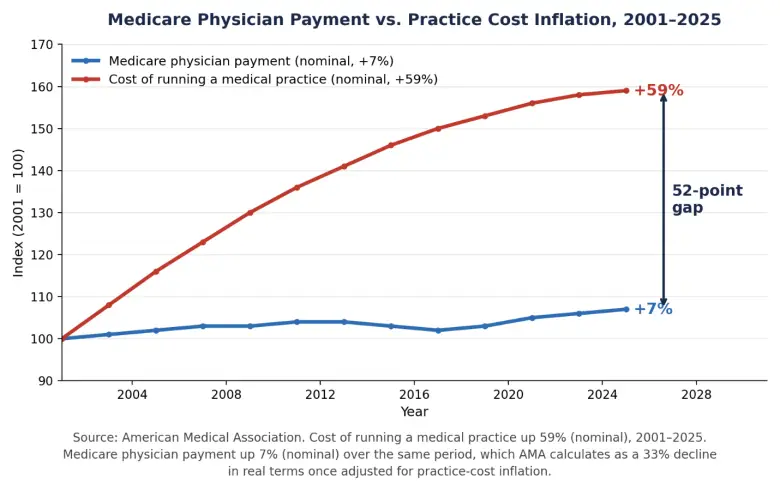
The second factor is economic, and it is a story about the insurance system. Adjusted for inflation, Medicare physician payment has declined 33% since 2001, even as the cost of running a medical practice rose 59% over the same period, according to data compiled by the American Medical Association.
In a high-cost market like New York City, this gap is even more pronounced. Medicare reimburses a typical office visit in Manhattan just 13% above the national baseline, while medical office rents are approximately 128% higher than the national average and malpractice insurance for internists can cost roughly 50% more than in many other U.S. markets. The economics of delivering unhurried, attentive primary care are particularly challenging when reimbursement adjustments fail to reflect the actual cost of operating a medical practice.
The third factor is the one patients feel most directly. Insurance was designed to pay for medical events: lab tests, diagnostic imaging, vaccines, procedures, prescriptions, specialist care, emergency services, surgeries, and hospitalization. The payment system is built around discrete billable encounters. Most physicians would prefer to spend more time with every single patient. Memberships make that structurally possible. Your insurance continues to cover the services it is designed to cover. The membership fee covers the physician’s time and relationship in its entirety.
What concierge medicine means in practice
What that access actually looks like is easiest to see in specific moments, not in the abstract. Here are ten of them.
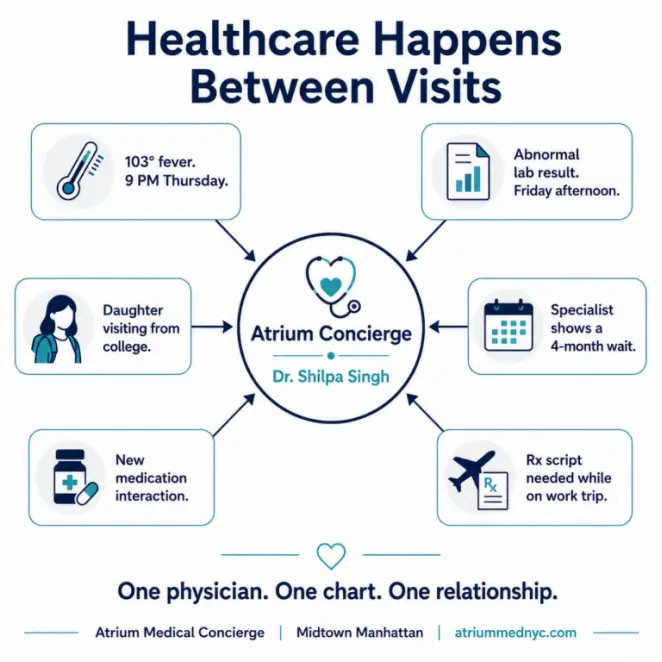
1. You need an appointment on Friday morning for something that feels urgent but is not ER-level. The earliest slot available is three days out on a Monday.
Text or call Dr. Singh’s cellphone directly. The appointment is scheduled the same afternoon.
2. It is 9 PM on a Saturday. You have a 103-degree fever and are weighing a three-hour urgent care wait against a $750 ER deductible for an out-of-network facility.
Text or call Dr. Singh’s cellphone directly. She assesses the situation over the phone, advises on next steps, and if needed, calls in a prescription or directs you to the right level of care. You do not have to guess.
3. Your insurance denies a medication that should be covered. The letter says "not medically necessary" and gives you fifteen days to appeal.
Text or call Dr. Singh’s cellphone directly. Her team reviews the denial, checks the plan requirements, prepares the clinical documentation, submits the appeal, and follows it through.
4. You are traveling for work and need a prescription or a lab order.
Text or call Dr. Singh’s cellphone directly. The order is handled remotely.
5. Your 22-year-old daughter is visiting from college and woke up with symptoms.
Text or call Dr. Singh’s cellphone directly. Family coverage extends to children under 26.
6. The specialist your cardiologist referred you to has a six-month wait, and the insurance referral requires documentation you have not yet pulled together.
Text or call Dr. Singh’s cellphone directly. She coordinates with the specialist at a peer-to-peer level, communicates the clinical urgency, and makes sure the referral pathway and insurance requirements are handled correctly.
7. An abnormal lab result came back while you were in the middle of a meeting.
Text or call Dr. Singh’s cellphone directly. She explains the finding and tells you what happens next so you are not anxious for the next several hours or days.
8. You need pre-operative medical clearance and the surgical window is two weeks away.
Text or call Dr. Singh’s cellphone directly. Clearance is handled within a day or two, with the completed form sent directly to your surgical team.
9. A new medication started by a specialist may be interacting with something else you already take.
Text or call Dr. Singh’s cellphone directly. She reviews the interaction, advises on whether to hold the medication, and contacts the specialist if needed.
10. You paid over $500 for an online biomarker dashboard and seven markers came back “flagged”.
Text or call Dr. Singh’s cellphone directly. She reviews the full panel in the context of your history, symptoms, medications and goals, separates meaningful signals from noise, and decides what actually deserves follow-up. Sometimes the answer is another test. Sometimes it is treatment. Sometimes it is doing absolutely nothing.
Concierge medicine is often described as premium care, but at Atrium the practical difference is simpler: it gives patients a physician who can act on their history immediately, without the structural constraints that insurance creates. The membership fee is not for a luxury waiting room or superficial frills. It is for the block of Dr. Paradkar Singh’s clinical time that only 200 people have access to.
The concierge medicine spectrum
Concierge programs vary widely in price and structure. Industry research puts mid-tier concierge memberships in the $3,000 to $10,000 per year range, at approximately 39% percent of the U.S. concierge market. Memberships above $10,000 are the fastest-growing tier. At the far end, ultra-premium private medicine programs can run into five figures or more annually.
Atrium’s concierge program sits at the accessible end of that spectrum, and with a smaller panel than the concierge norm. Membership is $2,700 per year ($225/month), and the panel is capped at 200 members, below the 300 to 600 patient range typical of concierge and direct primary care practices nationally.
The specialist referral difference
Nationally, the average wait for a new-patient specialist appointment is 31 days, and it can run past 40 days for specialties like gastroenterology and OB/GYN, according to AMN Healthcare’s 2025 Survey of Physician Appointment Wait Times, which covers New York among the 15 major metro areas surveyed. That is the baseline. A referral moving through scheduling desks, referral queues, and insurance authorization on top of that baseline often takes longer still. None of it reflects anything the patient did wrong. It is what happens industry-wide when a system built for volume has to route an individual case through an insurance-driven referral process.
Dr. Paradkar Singh adds a direct channel on top of the standard referral process as part of the concierge program. She maintains personal relationships with specialists across cardiology, gastroenterology, endocrinology, dermatology, ophthalmology, and OB/GYN, physicians she can call or text directly rather than route through a scheduling desk. That kind of call carries a different weight than a referral letter moving through a queue. For a patient who just received an abnormal result and needs answers, the difference between waiting a month and obtaining a same-week appointment can materially change both the patient’s anxiety and the speed of the clinical workup.
Dr. Singh brings to bear her network of specialists across NYU Langone, Lenox Hill, Mount Sinai, Weill Cornell, HSS, and Memorial Sloan Kettering. Concierge patients do not lose access to any specialist or hospital system. They gain a direct line to a physician actively working that system on their behalf.
Prior authorization and medication access
Prior authorization is where many patients discover that having insurance is not the same thing as getting care. A medication may be on formulary but still require documentation. An imaging study may be appropriate but still delayed. A specialist referral may be covered but still buried behind process. The system is not designed to fail you. It is designed for volume, and individual cases fall through the gaps.
The dedicated time built into the concierge panel allows Dr. Singh’s team to proactively initiate, track, follow up on, and when appropriate, appeal these authorizations. That is not a peripheral benefit. For patients on specialty medications, managing chronic conditions, or dealing with complex multi-specialist care, it is often the most valuable thing the membership provides.
In practice, this has made a meaningful difference for patients seeking coverage for certain specialty medications, including GLP-1 therapies, where the approval process can be complex and the initial denial rate is high. In some cases, a successful prior authorization outcome has effectively covered the cost of annual concierge membership in medication savings alone. This is not guaranteed. But it reflects what proactive physician advocacy can accomplish inside an insurance system where persistence, follow-through, and clinical documentation quality often determine the outcome.
Who concierge medicine is for
Concierge medicine at Atrium is best suited for patients who want a long-term, high-continuity relationship with a board-certified internist, more dedicated time per visit, and a direct line to that physician between visits.
| Patient profile | Why concierge care fits |
|---|---|
| Patients tired of insurance friction, high copays and deductibles | Concierge membership gives direct access to Dr. Singh. |
| Executives, professionals, and frequent travelers | Need predictable access regardless of schedule, time zone, or travel calendar. |
| Patients with complex medical histories | Multiple medications, chronic conditions, or multi-specialist care requiring consistent, knowledgeable oversight and a physician who knows the full picture. |
| Patients approaching Medicare eligibility | Proactive preventive care and transition planning before Medicare enrollment, with a physician who can help navigate what changes and what doesn't. |
| Families with coverage needs | Children under 26 covered. Out-of-town access included. |
| Patients focused on healthspan and longevity | Time to evaluate advanced biomarkers with clinical context, not a wellness-account recommendation list. |
| Senior executives and corporations evaluating it as a benefit | Many employers already fund an annual executive physical, often through HSA or FSA funds. A concierge membership extends that logic across the full year. |
A different approach to functional medicine
Dr. Singh grew up in India, where ideas that would now be called “holistic medicine” were simply part of everyday life. Ayurveda, herbs, food as medicine, yoga, and the connection between how you live and how you feel were not alternative concepts. They existed alongside conventional medical care.
She then trained in a very different tradition: rigorous Western internal medicine, where a diagnosis has to withstand scrutiny, treatments should be supported by evidence, and data matter.
Her approach today draws something important from both worlds.
Modern medicine is extraordinarily good at treating disease. But there is also a large space between nothing is wrong with you and you have a disease that requires treatment. A patient may be exhausted, gaining weight, sleeping poorly, losing muscle, entering perimenopause, struggling with insulin resistance, or looking at an advanced biomarker panel full of abnormalities while being told that their standard labs are “normal.” Those concerns deserve more than reassurance. They deserve investigation.
That is where thoughtful functional medicine can be useful. But more testing is not automatically better medicine.
Dr. Singh does not believe in the testing circus that has grown up around parts of the wellness industry: ordering dozens or hundreds of biomarkers simply because they can be measured, turning every result outside a reference range into a problem, and then matching those “problems” to a branded supplement stack or protocol. A flag on a dashboard is not a diagnosis.
The Atrium approach starts with a more basic question: what are we actually trying to understand about you?
Sometimes that means going beyond the conventional annual physical. It may mean looking at ApoB or Lp(a) when cardiovascular risk deserves a deeper look; fasting insulin when the metabolic picture does not make sense from glucose alone; ferritin when fatigue or hair loss has been dismissed; hormone testing when symptoms and life stage make it relevant; or reviewing the 100-plus biomarkers a patient has already purchased through a direct-to-consumer platform and deciding which five actually matter.
But the laboratory result is only one piece. Dr. Singh puts it alongside your symptoms, family history, medications, sleep, nutrition, exercise, menstrual or hormonal history, stress, body composition, and what has changed in your life. The goal is not to accumulate more data. It is to understand the pattern.
Then comes the part that medicine sometimes makes unnecessarily ideological: deciding what to do about it.
Sometimes the answer is nutrition. Sometimes it is resistance training, better sleep, less alcohol, correcting a deficiency, or simply giving the body time. Exercise and nutrition are not consolation prizes before “real” treatment; they are among the most powerful forms of medicine we have.
Sometimes a supplement has a legitimate role. And sometimes the body needs a hand that lifestyle alone is unlikely to provide, and the appropriate answer is medication.
Dr. Singh is comfortable with all three because she is committed to none of them as an ideology. The treatment should follow the patient and the evidence, not the business model of the person interpreting the test.
That balance is Atrium’s philosophy of functional medicine: measure what is useful, understand the whole person, treat what matters, and leave the noise alone.
Membership pricing, insurance, and what the fee covers
Membership is $2,700 per year, billed annually. That works out to $225 per month.
Most commercial insurance plans do not cover concierge membership fees. However, many HSA and FSA programs allow members to use pre-tax funds toward enhanced care. The 2026 HSA contribution limit is $4,400 for self-only coverage. Check with your benefits administrator.
For many patients, the relevant calculation is not the membership fee in isolation. It is the annual cost of urgent care visits, ER copays and deductibles, and the value of a prior authorization outcome with dedicated physician advocacy that may significantly impact out-of-pocket costs.
For senior executives, this is often a familiar category rather than a new one. Many companies already budget for an annual executive physical which costs thousands of dollars, frequently through HSA or FSA funds. Concierge membership can be viewed the same way, with the benefit extending across the full year instead of a single visit.
To discuss current membership availability, call 212-457-1722. Membership enrollment and supplemental benefits are administered through SignatureMD; all clinical care remains with Dr. Paradkar Singh and the Atrium Medical team. Capacity is limited by the 200-member panel cap.
What the membership fee covers
- Direct 24/7 access to Dr. Paradkar Singh
- Same-day appointments when clinically appropriate
- Longer, unhurried visits without time pressure
- After-hours guidance and prescription management
- Specialist coordination and referral advocacy
- Prior authorization initiation, tracking, and appeals
- Proactive follow-up on labs, imaging, and specialist results
- Family coverage for children under 26
- Longevity and healthspan consults and referrals
- Out-of-town access and remote care coordination
What insurance still covers
- Laboratory testing (billed through insurance when applicable)
- Diagnostic imaging (billed through insurance when applicable)
- Medications and prescriptions (billed through pharmacy benefit)
- Vaccines and immunizations (billed through insurance when applicable)
- In-office procedures (billed through insurance when applicable)
- Specialist visits and consultations (billed through insurance when applicable)
- Emergency services and hospital care
About Dr. Shilpa Paradkar Singh
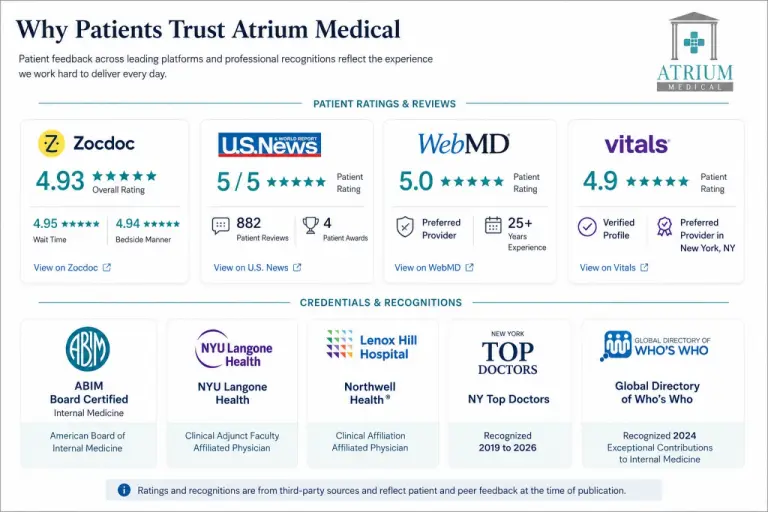
View source profiles: Zocdoc | U.S. News | WebMD | Vitals | NY Top Doctors
Concierge medicine offers many conveniences, but at its core, it is about your relationship with your physician and the trust you place in them. We believe those human elements — judgment, communication, and continuity matter far more than any amenity. Indeed, they are the very foundation upon which every Atrium patient-clinician partnership is built.
Dr. Shilpa Paradkar Singh is the founder of Atrium Medical and a board-certified internal medicine physician with over 20 years of clinical experience, 14 of them serving patients in New York City. She completed her residency at Mount Sinai Hospital and currently maintains clinical adjunct faculty appointments at NYU Langone Health and Lenox Hill Hospital.
"I've been a patient of Dr. Singh's for 11+ years, from when she ran things at Yaffe Ruden and Associates. Signed up for her concierge practice at Atrium when she launched last year and couldn't love it more. She practically saved my life last fall by seeing me same day before an overseas trip which would have proved calamitous if I hadn't taken her advice. The ability to text her directly is gold for my peace of mind."
★★★★★
Verified patient review, WebMD
Before founding Atrium Medical in 2018, she served as Medical Director of Yaffe Ruden and Associates, a cornerstone of Upper East Side medicine since the 1980s. Her background also includes tenure as an internist at Ninth Street Internal Medicine and service as adjunct faculty at Pennsylvania Hospital. She remains deeply integrated into the city’s medical community, currently serving on the Clinical Practice Committee of the NYU Langone Physician Network. Dr Singh is a SignatureMD member physician and has been recognized annually by New York Top Docs since 2018.
"Dr. Shilpa Singh is the best of the best, experienced and very knowledgeable and trustworthy. She is also very friendly and has great communication skills. I am an 84 years old woman and obviously when I say she is the best it's been many doctors to choose from. I feel very lucky to have her as my primary physician."
★★★★★
Verified patient review, Google
Dr. Singh established Atrium Medical as an independent, physician-led practice designed for those who prioritize clinical excellence and a personal, reliable partnership with their clinician. Her concierge program extends this model to a deliberately capped membership panel, ensuring the time and direct communication necessary for nuanced medical decision-making that goes beyond the constraints of a traditional office visit.
"Went to her with an elevated white blood count last year. She repeated the labs and gently pushed me to go see an oncologist, did not panic me but was just the right amount of calm firmness. She saved my life. Dr. Singh is far too self-effacing for the seasoned yet so young internist that she is."
★★★★★
Verified patient review, Healthgrades
Meet the Atrium Medical team to read more about Dr. Singh and the clinicians dedicated to your care at Atrium Medical Primary Care in Midtown Manhattan.
Standard care at Atrium: what stays the same
The concierge program has limited capacity by design. Patients who do not enroll continue receiving care from Atrium Medical’s clinical team, the same independent, physician-led internal medicine practice that has served more than 10,000 New Yorkers since 2018. Atrium has spent eight years building its reputation on clinical excellence. The concierge program extends what is structurally possible for a small group of patients.
Standard care at Atrium still includes same-day and next-day access when available, most major insurance plans, board-certified internal medicine, annual physicals, and the full range of preventive and acute services published on this site. The concierge program is an upgrade in access. It is not a division of clinical quality.
How to inquire about membership
To inquire about concierge membership availability, call 212-457-1722. If you are a current Atrium patient, mention your interest to the front desk at your next visit or call during office hours.
Atrium Medical is located at 160 East 56th Street, 12th Floor, Midtown East Manhattan, three blocks south of the 59th Street subway hub, convenient to Park Avenue, Lexington Avenue, Grand Central, Sutton Place, and the broader Midtown office corridor.
Concierge Medicine FAQ
What is concierge medicine?
Concierge medicine is a membership-based model in which patients pay a fee for enhanced access to their physician. The physician limits their concierge panel, which enables longer visits, same-day access, after-hours availability, and direct communication. Insurance continues to cover medical services. The membership fee covers the access layer. The patient has peace of mind knowing their primary care is fully covered and can continue to use insurance for labs, medications, testing, imaging, emergency services, surgeries, hospitalizations, etc.
Why has concierge medicine become more popular?
A growing driver is insurance frustration: patients increasingly recognizing that having insurance and getting the care they need may not be the same thing.
How much does concierge membership cost at Atrium?
Atrium’s concierge membership is $2,700 per year, equivalent to $225 per month. This fee covers the access layer: physician availability, direct communication, longer visits, after-hours guidance, specialist coordination, and prior authorization support. Medical services, including labs, specialist visits, imaging, and procedures, continue to be billed through insurance when applicable.
Does insurance cover the concierge membership fee?
Most commercial insurance plans do not cover concierge membership fees. However, many HSA and FSA programs allow members to use pre-tax funds toward enhanced care. The 2026 HSA contribution limit is $4,400 for self-only coverage.
What happens if I need care after hours as a concierge patient?
Concierge members have 24/7 availability through Dr. Paradkar Singh’s direct line. After-hours and weekend concerns, prescription questions, and urgent medical questions can be addressed directly without a call center, portal queue, or urgent care visit.
How does specialist referral work for concierge patients?
Dr. Paradkar Singh adds a direct channel on top of the standard referral process, calling or texting specialists she knows personally rather than routing through a scheduling desk. Nationally, new-patient specialist appointments average 31 days and can run past 40 for specialties like gastroenterology and OB/GYN, according to AMN Healthcare’s 2025 survey. A direct call from a physician colleague, with clinical context already communicated, can mean days instead of weeks.
Why is the concierge panel capped at 200 members?
A dedicated block of time, same-day scheduling, and a direct line are not things that can be realistically extended to an unlimited number of people. Atrium Medical has cared for more than 10,000 New Yorkers through its standard practice. The concierge panel is capped at 200 because that scale is what makes 24/7 direct access structurally possible.
Can my children or family members be covered?
Concierge membership at Atrium includes coverage for children under 26 and out-of-town coverage. Contact us to discuss specific family coverage details and current membership structure.
What if I am not ready to join the concierge program?
Patients who do not enroll continue receiving the same exceptional care from Atrium Medical’s clinical team under the standard independent primary care model that has served more than 10,000 New Yorkers since 2018. The concierge program is an upgrade in access, not a prerequisite for care. If you become interested later, ask about current availability.
Is the concierge program available to new patients?
Yes, subject to availability. New patients interested in concierge enrollment should call 212-457-1722 to check current panel availability.
Can concierge membership work as an employee benefit or executive perk?
Many employers already fund an annual executive physical, often through HSA or FSA funds. A concierge membership fits the same category, extending that benefit year-round instead of a single visit. At $2,700 per year, it may use part of the annual HSA contribution limits available to many professionals. Check with your administrator.
Clinical sources and references
This page was reviewed by Atrium Medical Primary Care. Sources may be updated as guidelines change.
- American Medical Association: Medicare physician payment vs. practice cost inflation
- AAMC: physician shortage and aging population projections through 2036
- Annals of Family Medicine: patient panel size and team-based primary care
- Grand View Research: U.S. concierge medicine market report
- AAFP: direct primary care policy statement
- SignatureMD: Atrium Medical concierge program
- McKinsey: Future of Wellness 2025, Gen Z and millennial wellness spending
- Forbes Health: survey on spending to increase healthy life expectancy
- AMN Healthcare: 2025 Survey of Physician Appointment Wait Times
- Centers for Medicare & Medicaid Services (CMS). Medicare Physician Fee Schedule Look-Up Tool, 2026. National and Manhattan locality reimbursement rates for established-patient office visits (CPT 99214).
- JLL, as reported by The New York Times. "As Office Rents Rise, Doctors Get Creative." January 17, 2026. Manhattan outpatient medical office asking rents average $58 per square foot annually.
- CBRE Research. "Q2 2026 U.S. Medical Outpatient Buildings Figures." August 17, 2026. National average medical outpatient office asking rent of $25.46 per square foot annually.
- MEDPLI. "2026 New York Malpractice Insurance Guide." Estimated annual malpractice premium of $29,580 for internal medicine without surgery, based on $1 million/$3 million coverage.
.footer-container {
display: flex;
align-items: center;
justify-content: center;
gap: 10px;
width: 100%;
}
/* Desktop ke liye: Wrap band rakho */
@media (min-width: 769px) {
.footer-container {
flex-wrap: nowrap;
}
}
/* Mobile ke liye: Wrap chalu rakho */
@media (max-width: 768px) {
.footer-container {
flex-wrap: wrap;
text-align: center;
}
}